


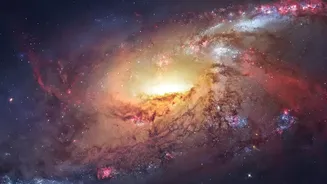
A Galactic Time Machine
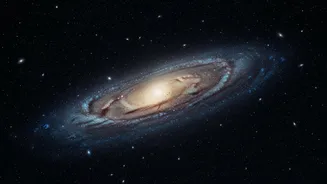
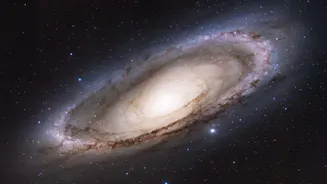
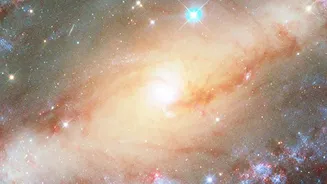
To read Andromeda’s past, astronomers embarked on a colossal project using the Hubble Space Telescope. Combining two massive surveys, the Panchromatic Hubble Andromeda Treasury (PHAT) and the Panchromatic Hubble Andromeda Southern Treasury (PHAST), they
meticulously mapped two-thirds of the galaxy’s sprawling disk. The effort, which took over a decade and thousands of observations, captured the light of some 200 million individual stars across a vast area. This unprecedented stellar census is what allows scientists to act as cosmic historians. According to Ben Williams, an astronomer involved in the study, Hubble is uniquely capable of providing the sharp, wide-ranging view needed to analyse individual stars, which he calls the "fossil record of the galaxy's formation".
Reading the Stellar Fossil Record
So, how do stars tell a galaxy’s life story? It comes down to their colour and lifespan. Massive stars burn incredibly hot and bright, giving them a distinct blueish glow, but they live fast and die young. Smaller, less massive stars are cooler, appear redder, and can shine for billions of years. By mapping the locations of these different types of stars, astronomers can create a timeline. Regions dominated by brilliant blue stars are areas of recent or ongoing star birth, while regions with a reddish hue are home to older, more settled stellar populations. By dividing the galaxy into thousands of smaller sections and analysing the stellar mix in each, scientists can rewind time and see when and where Andromeda was most active.
Andromeda's Golden Age and Long Fade
The data reveals a dramatic history. About two billion years ago, Andromeda experienced a major burst of activity, likely triggered by an encounter or merger with a smaller galaxy. Since then, however, its creative energy has been winding down. The decline has been steady for the last 500 million years, but it became even more pronounced in the last 40 million years. Half a billion years ago, Andromeda was churning out new stars at a rate of about one Sun's mass per year. Today, that rate has plummeted to just one-fifth of a solar mass annually. This slowdown is not because the galaxy is running out of the necessary gas and dust. Instead, it seems to be in a natural cooling-off period after its earlier, more vigorous phase. As lead author Tobin Wainer described it, "It's just like after running a marathon, sometimes you've got to take a bit of a breather."
A Tale of a Fading Ring
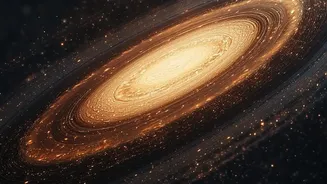
The decline isn't uniform across the entire galaxy. Researchers discovered that most of Andromeda's recent star-making activity has been concentrated in a massive ring-like structure about 32,000 light-years from the galactic centre. It is the fading of this stellar nursery that is driving the galaxy's overall slowdown. Astronomers also explored other potential causes, such as the influence of Andromeda’s small companion galaxy, M32. They found evidence of decreased star formation in the area near M32, which could suggest an interaction around 60 million years ago disrupted the star-birthing process there. While a direct link hasn't been proven, scientists consider M32 a likely suspect in contributing to the local decline.
A Glimpse into Our Own Future
Andromeda’s story is more than just a history of a distant galaxy; it’s a potential preview of what lies ahead for our own Milky Way. Both galaxies are giant spirals of a similar age and size, and understanding Andromeda's evolution helps us model our own cosmic future. The most dramatic chapter in that shared future is their eventual collision. Pulled together by gravity, the Milky Way and Andromeda are on a path to merge in roughly 4.5 billion years. While star-on-star collisions will be rare, the gravitational chaos will compress vast clouds of gas and dust, triggering a massive burst of new star formation and creating a new, giant elliptical galaxy sometimes dubbed "Milkomeda". This spectacular event will temporarily reverse the decline, creating a firestorm of activity before the new, larger galaxy eventually settles into its own long, quiet retirement.