



Meet the Astronaut
Anil Menon, a 49-year-old US Space Force colonel and emergency physician, is living a dream millions share but few achieve. Born in Minneapolis to parents of Indian and Ukrainian heritage, his connection to India is profound. His father hails from Kerala,
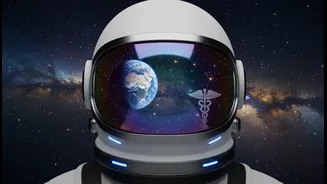
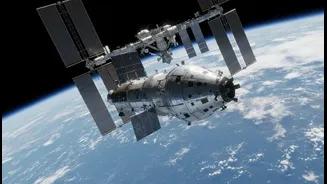
and Menon himself spent a year in India as a Rotary Ambassadorial Scholar supporting polio vaccination efforts. His journey to NASA is a testament to a lifetime of service in extreme environments, from serving as a frontline flight surgeon in Afghanistan to providing medical care to climbers on Mount Everest. Before being selected as a NASA astronaut in 2021, he was SpaceX's first flight surgeon, helping to build its medical program for human spaceflights. Now, aboard the International Space Station (ISS) for an eight-month mission that began on July 14, 2026, he is making history.
A Mission Beyond the Horizon
Menon launched aboard a Soyuz MS-29 spacecraft from Kazakhstan alongside two Russian cosmonauts, embarking on a mission that is packed with scientific objectives. As a member of the Expedition 74/75 crew, his focus is on research that is critical for future deep-space exploration, including missions to the Moon and Mars. A significant part of his work involves studying the physiological effects of long-duration spaceflight on the human body, such as how microgravity impacts blood flow and composition. But what makes this assignment particularly groundbreaking is its integration of futuristic technologies that could change how astronauts work and live in space.
AI as an Onboard Medical Expert
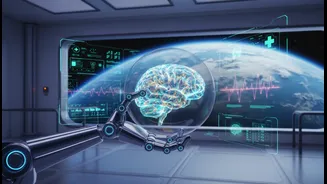
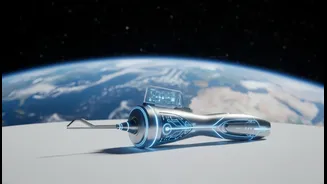
One of the key experiments Menon will be involved with is testing an AI-assisted ultrasound system. For long voyages to Mars, where communication with Earth can have significant delays, astronauts need to be more medically autonomous. NASA is developing tools like the 'Crew Medical Officer Digital Assistant', an AI designed to help diagnose and treat medical issues without real-time guidance from doctors on the ground. Menon will help test and refine systems that use AI to analyze ultrasound scans and identify organs, a critical step toward creating a self-sufficient medical toolkit for space explorers. This AI doesn't just promise to keep astronauts safe; the technology could also revolutionize remote medical care in underserved areas on Earth.
Seeing Repairs Through Augmented Reality
Alongside AI, Menon's mission will utilize augmented reality (AR) to enhance complex tasks. Imagine trying to repair a complex piece of machinery while floating in zero gravity, with tools and manuals drifting away. It’s a significant challenge. NASA's T2 Augmented Reality (T2AR) project uses headsets like the Microsoft HoloLens to overlay digital instructions, diagrams, and video directly onto an astronaut's field of view. This allows them to keep both hands on the task at hand, whether it's maintaining the station's treadmill or performing delicate scientific procedures. Menon will perform ultrasound procedures using AR guidance, helping to validate systems that will allow future crews to conduct complex medical examinations independently.
Building the Future, One Experiment at a Time
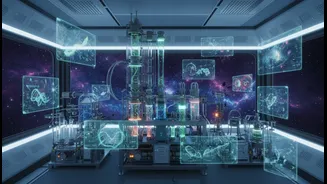
The experiments featuring AI and AR are more than just tech demos; they are foundational for humanity's next giant leap. By increasing astronaut autonomy, these tools reduce the reliance on constant communication with Mission Control, a necessity for missions deeper into the solar system. Menon will also contribute to research on manufacturing semiconductor crystals in space, which could lead to breakthroughs in high-performance computing and AI systems back on Earth. His work on bioprinting vascular structures in microgravity could also provide new insights into the aging process. Each task performed is another data point, another step toward making long-duration spaceflight safer and more efficient.