







Quantum computing often sounds like science fiction, but the European Union is betting billions that it’s the key to solving some of the world’s biggest challenges. So what are these futuristic machines, and how could they change our lives?
What is Quantum Computing, Really?
Before diving
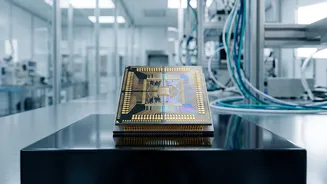
into its applications, it helps to understand what makes a quantum computer so different from the device you're reading this on. Classical computers, from your smartphone to the most powerful supercomputers, process information using 'bits', which are either a 0 or a 1. It’s a binary, on-or-off system. Quantum computers use 'qubits'. Thanks to the principles of quantum mechanics, a qubit can be a 0, a 1, or both at the same time—a state called superposition. When multiple qubits are linked, a phenomenon called entanglement means they can influence each other instantly, even when separated. This allows quantum computers to explore a vast number of possibilities simultaneously, making them incredibly powerful for solving specific, complex problems that would take a classical computer millions of years.
The EU’s Quantum Leap
Recognising the transformative potential of this technology, the European Union has launched ambitious initiatives to establish itself as a global quantum leader. The Quantum Flagship, a €1 billion, 10-year program, aims to turn Europe's world-class quantum research into real-world commercial applications. More recently, in late 2026, the European Commission proposed a 'Quantum Act' to further coordinate efforts, build industrial capacity, and secure supply chains. The goal is to move from scientific leadership, where Europe already excels, to industrial and market leadership, preventing a brain drain and dependency on the US and China, who are also investing heavily. The EU envisions a 'quantum web' where computers, sensors, and communication networks work together to unlock new capabilities.
A New Era for Medicine
One of the most promising applications for quantum computing is in drug discovery and development. Designing a new drug is incredibly slow and expensive, partly because it involves understanding how a potential drug molecule will interact with complex proteins in the human body. Classical computers struggle to accurately simulate these molecular interactions. Quantum computers, however, operate on the same quantum principles as the molecules themselves, allowing for far more precise simulations. Researchers hope to use them to predict a drug's effectiveness, toxicity, and side effects before it ever reaches a lab, dramatically speeding up the discovery of new medicines for diseases like Alzheimer's and even enabling more personalized treatments based on an individual's genetic makeup.
Powering the Future with Better Batteries
Another major challenge quantum computers could help solve is the urgent need for better batteries. As the world shifts to electric vehicles and renewable energy, the demand for more efficient, longer-lasting, and faster-charging energy storage is immense. However, improving battery chemistry is a complex trial-and-error process. Quantum computers can simulate the intricate chemical reactions inside a battery at the atomic level, something today's computers cannot do effectively. This would allow scientists to model and test new materials and chemical combinations virtually, accelerating the discovery of next-generation batteries that are more powerful, safer, and made from cheaper, more sustainable materials.
The Quantum Horizon
While drug discovery and battery technology are key focus areas, the EU's quantum ambitions don't stop there. The technology has the potential to revolutionise logistics by solving complex optimisation problems, create unhackable communication networks, and develop ultra-precise sensors for everything from medical imaging to satellite-independent navigation. The road ahead is long; large-scale, fault-tolerant quantum computers are still in their early stages of development. But by investing now through initiatives like the Quantum Act and the Sovereign Tech Equity Fund, the EU is positioning itself to be a key player in a technological revolution that promises to reshape industry, security, and society itself.