







What is the MMX Mission?
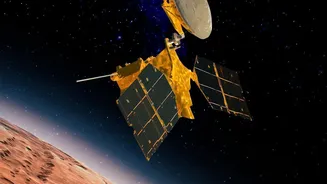
MMX stands for Martian Moons eXploration, a mission led by the Japan Aerospace Exploration Agency (JAXA). Its destination is the Mars system, but its primary targets are the planet's two small, enigmatic moons: Phobos and Deimos. This is no simple flyby.
MMX is one of the most complex robotic missions ever attempted, aiming to orbit Phobos, deploy a rover onto its surface, land to collect a physical sample, and then return that precious cargo to Earth. It builds on the success of JAXA's previous sample-return triumphs, the Hayabusa and Hayabusa2 missions, which brought back pieces of asteroids. MMX is set to be the first mission to bring back material from the Martian system.
The Central Mystery: Captured Asteroids or Giant Impact?
For decades, scientists have debated the origin of Phobos and Deimos. Their small size and irregular shape suggest they could be asteroids that wandered too close to Mars and were captured by its gravity billions of years ago. However, another leading theory proposes they formed from debris thrown into orbit after a massive object collided with a young Mars, similar to how Earth's Moon is thought to have been created. Each theory has profound implications. If they are captured asteroids, their composition could tell us about the building blocks of the outer solar system. If they are pieces of Mars, the samples could offer a glimpse into the Red Planet's ancient past, a time when it may have been more habitable. MMX aims to finally provide the evidence needed to solve this puzzle.
A Five-Year Interplanetary Itinerary
The mission's five-year timeline is a carefully planned sequence of complex manoeuvres. The journey to Mars itself will take about a year, with the spacecraft expected to arrive in the planet's orbit around August 2027. From there, it will spend roughly three years in the Mars system, primarily focused on Phobos. The spacecraft will enter what is known as a 'quasi-satellite orbit', allowing it to closely observe the moon, map its surface, and identify safe and scientifically interesting landing spots. After extensive surveying, the spacecraft will perform the daring landing and sample collection. It will also conduct several flybys of the smaller moon, Deimos, to gather comparative data. The final leg is the year-long journey back, culminating in the return of the sample capsule to Earth in 2031.
The Daring Sample Return
The highlight of the mission is the plan to collect at least 10 grams of material from the surface of Phobos. While that sounds tiny, for scientists it is a treasure trove. The spacecraft is equipped with two sampling systems: a corer to dig about two centimetres below the surface and a pneumatic system that uses a puff of nitrogen gas to blow surface grains into a collector. Before the main spacecraft lands, it will deploy a small, 25-kilogram rover named 'Idefix', developed by the French (CNES) and German (DLR) space agencies. This rover will explore the surface for about 100 days, analyzing the terrain and helping to prepare for the main event. This will be the world's first attempt to land on, rove, and retrieve a sample from a Martian moon.
An International Effort
While JAXA is leading the MMX mission, it is a truly global collaboration. NASA has provided key scientific instruments, including a spectrograph that will determine Phobos' chemical composition from orbit and contributed to one of the sampling mechanisms. The French and German space agencies jointly built the Idefix rover. The European Space Agency (ESA) is also a partner, contributing to communications and mission operations. This international cooperation is crucial for a mission of this scale, pooling resources and expertise to achieve ambitious scientific goals that benefit all of humanity.