







The End of a Lifeline
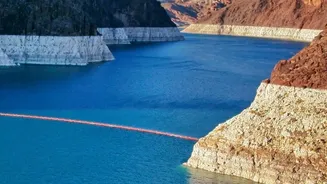
For a century, the Colorado River has been the lifeblood for 40 million people across seven states, quenching the thirst of cities like Phoenix and Los Angeles and irrigating millions of acres of farmland. That era is coming to a close. A historic megadrought,
intensified by a warming climate, has dramatically reduced the river's flow, leaving its two massive reservoirs, Lake Powell and Lake Mead, at dangerously low levels. The decades-old agreements that govern how the river's water is shared are set to expire at the end of 2026, and the states that depend on it are struggling to agree on who should bear the burden of the cuts. With its primary water source no longer reliable, the Southwest is being forced to confront a new reality and pursue radical, expensive, and technologically ambitious solutions to keep the taps from running dry.
Turning the Ocean into Taps
When your river runs low, the next logical place to look is the largest body of water on the planet: the ocean. The process of turning saltwater into fresh water, known as desalination, is rapidly moving from a last resort to a central strategy. In a landmark move, water agencies in Arizona and Nevada have signed agreements to explore a partnership with Southern California. The plan isn't to build a new pipeline across the desert, which would be astronomically expensive. Instead, Arizona and Nevada may help fund the expansion of existing desalination plants in California, like the billion-dollar facility in Carlsbad. In return, they would get access to a portion of California's share of the Colorado River water. Even more ambitious proposals involve building massive desalination plants in Mexico's Gulf of California and constructing a new, multi-billion-dollar pipeline system to pump the fresh water hundreds of kilometers across the border to cities like Phoenix.
The Ultimate Recycling Program
Another source of 'new' water is much closer to home: the water we've already used. Advanced Water Purification (AWP), sometimes dubbed 'toilet-to-tap', is a proven process that takes treated wastewater and puts it through a multi-stage, high-tech purification system to produce water that meets or exceeds drinking water standards. While the concept may sound unsettling, it's a technology that has been used safely for decades in places like Orange County, California, and even by NASA in space. Facing dwindling river supplies, Southwestern cities are now investing heavily in this technology. Phoenix is currently constructing its first AWP facility, and communities like Scottsdale, Arizona, have been using a similar process for over 30 years to recharge their underground aquifers. Proponents see AWP as one of the most reliable and drought-proof solutions available, creating a truly local and endlessly renewable water supply.
Billion-Dollar Pipe Dreams
Beyond desalination and recycling are the colossal engineering projects once thought to be the stuff of fantasy: long-distance pipelines to import water from wetter parts of the country. These ideas, long dismissed as too expensive or politically impossible, are being discussed again with renewed seriousness. Proposals have been floated to build thousand-mile-long pipelines to carry water from the Mississippi or even the Columbia River in the Pacific Northwest. While these massive interstate projects face enormous financial and regulatory hurdles, smaller-scale versions are already a reality. In Arizona, one town recently approved a multi-million dollar deal to pipe in water from a groundwater basin 90 miles away. In Texas, a 53-mile pipeline is already delivering groundwater to the Austin area. These projects signal a fundamental shift in how water is valued—no longer as a simple local resource, but as a precious commodity worth moving across vast distances at great cost.