




The Foundation: Understanding Balance
Before diving into a comparison, it’s helpful to understand what we mean by balance. It's not just about standing still. Static balance is the ability to hold a fixed position, like standing on one leg. Dynamic balance is about maintaining control while
your body is in motion, which is crucial for most real-world activities and sports. Both are governed by proprioception, often called our "sixth sense." This is your body's innate ability to sense its position and movement in space, thanks to sensors in your muscles, joints, and inner ear. Improving proprioception sharpens your balance, coordination, and can even help prevent injuries.
Zumba: Dancing to a Stable Core
Zumba is a high-energy dance fitness program that feels more like a party than a workout. Its balance challenge is rooted in dynamic, choreographed movements on a stable surface. The routines involve quick transitions between steps, turns, and shifting weight from side to side, all set to infectious Latin rhythms. These movements constantly force your core muscles—your abs, hips, and lower back—to engage and stabilize your body. Because the choreography requires you to move in multiple directions, often changing tempo, you are constantly training your body to react and maintain its center of gravity. It’s a full-body workout where improved balance and coordination are direct benefits of learning the dance routines.
Roller Skating: Gliding on a Line of Control
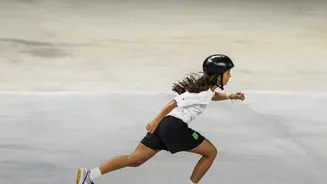
Roller skating presents a completely different kind of balance challenge. Here, the difficulty comes from maintaining stability on an unstable surface: wheels. The core requirement for skating is to keep your center of gravity low and stable while in motion. This is achieved by adopting a specific stance: feet shoulder-width apart, knees bent, and core engaged. Unlike Zumba's reactive balance, skating demands continuous, proactive adjustments to stay upright. Every push, glide, and turn requires subtle shifts in weight and constant core engagement. This activity is a masterclass in dynamic balance, as you are perpetually controlling your body's movement to prevent a fall, making it a highly effective workout for building stability and core strength.
The Core Differences in Balance Training
The fundamental difference lies in the environment and the nature of the movement. In Zumba, your feet are on solid ground, and the challenge is to control your body through a series of prescribed, often rapid, dance moves. You are reacting to choreography. This improves your ability to coordinate complex movements and quickly shift your weight without losing stability. Roller skating, on the other hand, places you on a constantly moving base. The challenge is less about following specific steps and more about mastering a state of continuous, self-directed control. It hones your proprioception in a way that feels like learning a new mode of locomotion entirely. Zumba trains balance through variety and coordination; skating trains it through sustained control on an unstable platform.
Enjoyment and Aerobic Payoff
Both activities are recognized as excellent forms of aerobic exercise, capable of burning hundreds of calories per hour and improving cardiovascular health. The enjoyment factor, however, is deeply tied to the balance challenge each presents. For those who love music and the energy of a group class, the thrill of mastering a Zumba routine provides immense satisfaction. The focus is on the fun of the dance, with the balance benefits coming almost as a side effect. For roller skaters, the joy often comes from achieving a 'flow state'—the meditative feeling of gliding smoothly and effortlessly. Mastering the balance required to skate freely in a park or at a rink is the primary goal, and the workout is the reward. Ultimately, one is a dance party that makes you stable, while the other is a lesson in gliding that strengthens your core.