



The Cosmic Collision Story
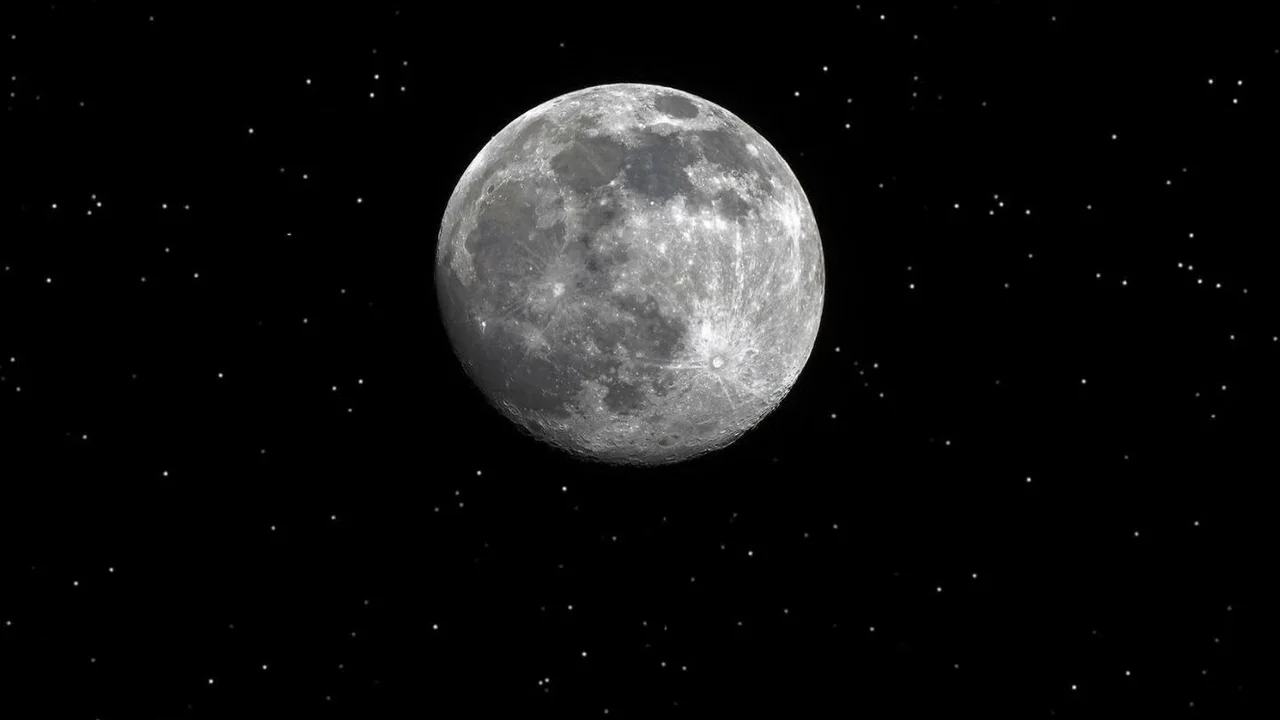
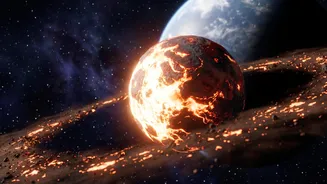
The most widely accepted explanation for the Moon's existence is the 'giant-impact hypothesis'. This theory suggests that about 4.5 billion years ago, when our solar system was still a chaotic construction zone, a Mars-sized protoplanet named Theia slammed
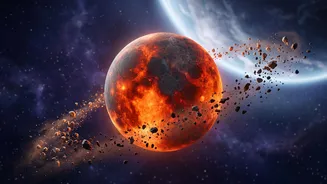
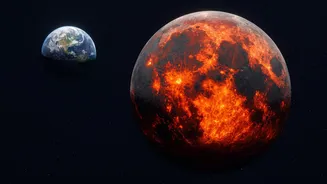
into the young Earth. The cataclysmic collision would have been energetic enough to melt and vaporize enormous amounts of rock, blasting a massive cloud of debris into orbit. For decades, scientists believed that this orbiting ring of super-heated material gradually clumped together over thousands or millions of years, eventually forming the Moon we know today. This story neatly explained several lunar mysteries, including why the Moon has a tiny iron core and why it was once covered in an ocean of magma.
Turning Up the Heat Changes Everything
Recent simulations are challenging the long-held idea of a slowly forming Moon. A study from researchers at the Southwest Research Institute found that the initial temperature of Theia and the proto-Earth is a surprisingly critical variable. Earlier models often treated the colliding worlds as fluids, largely ignoring the material strength of their rock. However, by incorporating temperature-dependent strength—recognizing that hotter rock is weaker and more deformable—the simulations produced dramatically different results. When the models simulated a very hot, and therefore weaker, Theia, the impact didn't just create a debris disk. Instead, the collision could produce a massive, largely intact proto-Moon that was flung directly into orbit within a matter of hours. In one scenario, a recognizable Moon formed in just five hours.
The Key Qualification to Keep in Mind
This is where the major caveat, or 'qualification', comes in. These findings do not prove the Moon formed in five hours; they show that it could have, under a specific set of initial conditions. The outcome of the simulated collision is highly dependent on the temperatures of the two bodies, something we can't know for sure. A colder, mechanically stronger Theia is more likely to shatter and produce the classic debris disk that leads to a slowly forming Moon. A hotter, weaker Theia is more likely to lead to the rapid, intact-Moon scenario. Since protoplanets were hotter earlier in the solar system's history, this finding creates a new link between how the Moon formed and when the impact happened. The key takeaway is that the simulations are tools for exploring possibilities, not definitive reconstructions of a past event.
Why This Detail Matters for the Lunar Puzzle
This new research adds a crucial layer of complexity to the lunar origin story. The temperature variable offers a potential pathway to resolving some long-standing issues with the giant-impact model. For example, scientists have long been puzzled by the fact that Earth and Moon rocks are isotopically almost identical. If the Moon formed mostly from Theia's debris, it should have a different chemical signature. While the new temperature models don't completely solve this conundrum, they change the dynamics of how material from Earth and Theia might have mixed. Ultimately, by refining the inputs of these cosmic simulations, scientists can test which scenarios produce a Moon that best matches the physical evidence we have today—from its composition and small core to its orbit and rotation.