







What Is the MMX Mission?
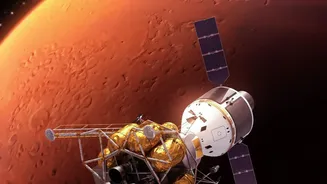
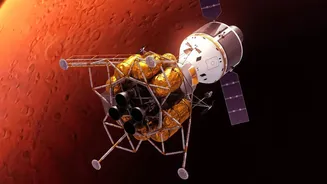
Led by the Japan Aerospace Exploration Agency (JAXA), the MMX mission is a highly ambitious robotic probe sent to study the two small moons of Mars, Phobos and Deimos. Its main goal is to do something never done before: land on Phobos, collect at least
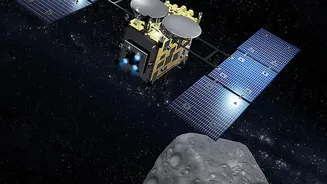
10 grams of surface material, and bring it back to Earth for analysis. Building on the success of its Hayabusa missions which returned samples from asteroids, JAXA is now applying that expertise to the Martian system. The mission is a major international collaboration, with instruments and expertise provided by NASA, the French space agency CNES, and the German Aerospace Center (DLR).
The Long Journey and Complex Timeline
Following its successful launch from the Tanegashima Space Center, the MMX spacecraft has begun its long cruise through space. It is expected to take about a year to reach the Red Planet, with arrival in Mars's orbit projected for August 2027. Once there, it won't rush in. The probe will spend about three years carefully observing Phobos and the more distant Deimos. During this time, it will map the surface to find a safe and scientifically interesting place to land. A key part of this phase involves deploying a small French-German rover named 'Idefix'. This rover will explore the surface for about 100 days, helping mission control select the final sampling site. The actual landing and sample collection are planned for 2030, with the precious cargo scheduled to return to Earth in 2031.
Why Phobos? The Mystery of the Martian Moons
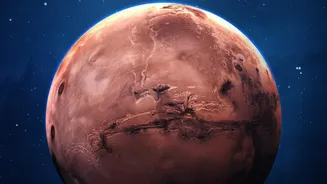
For scientists, Mars's moons are a major puzzle. There are two leading theories about their origin, and MMX hopes to provide the answer. The first theory is that Phobos and Deimos are captured asteroids, wanderers from the outer solar system that were snared by Mars's gravity long ago. If this is true, samples from Phobos could give us a pristine look at the building blocks of the solar system. The second theory is that the moons were formed from debris blasted into orbit after a giant object slammed into a young Mars. If this is correct, then Phobos is essentially made of ancient Martian material. By studying the samples, scientists will be able to determine the moon's composition and finally solve this mystery.
A Daring Sample Return
Collecting the sample is the mission's most complex phase. Phobos has extremely weak gravity—a 25kg rover on Earth will weigh only about 15 grams there—making a traditional landing difficult. The main spacecraft plans to make one or two landings, each lasting only a few hours. It will use two different systems to gather material. One is a coring device on a robotic arm that will dig a few centimetres into the surface. The other is a pneumatic sampler that will fire a puff of nitrogen gas to blow surface grains into a collection container. After securing its samples, the probe will perform several flybys of Deimos before beginning its year-long journey home in late 2030.
What We Hope to Learn
The tiny sample from Phobos could trigger huge revelations. Analyzing it in labs on Earth will allow scientists to use powerful equipment that could never be sent to space. If Phobos is a captured asteroid, its material could hold clues about the delivery of water and organic compounds—the ingredients for life—to the inner planets. If it's made of ancient Mars, the sample could reveal what the Red Planet was like billions of years ago, when it had a thicker atmosphere and liquid water. In either case, the mission's findings will profoundly impact our understanding of how rocky planets like Earth and Mars form and evolve. It's a critical step not just for understanding our neighbours, but also for appreciating our own planet's history.