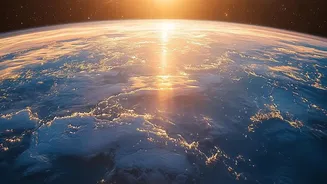


The sunlight that warms your face on a bright morning has been on an epic journey. While that journey ends with a quick eight-minute sprint across space, the full story of that light is far older and more complex than you might imagine.
The Cosmic Speed Limit
The eight-minute
travel time is a direct consequence of two simple facts: the vast distance between the Sun and Earth, and the cosmic speed limit. Light travels through the vacuum of space at approximately 300,000 kilometres per second. Nothing in the universe can travel faster. Our planet orbits the Sun at an average distance of about 150 million kilometres. If you do the maths—dividing the distance by the speed—you get about 500 seconds, which translates to 8 minutes and 20 seconds. Because Earth's orbit is slightly elliptical, not a perfect circle, this time can vary slightly, from about 8 minutes and 10 seconds at our closest point to 8 minutes and 27 seconds at our farthest.
A Journey That Starts Millennia Ago
Here's where the story gets truly mind-bending. The 8-minute-and-20-second trip is only the final leg of the journey. The particles of light, called photons, that reach us today didn't start at the Sun's surface. They were born deep within the Sun's core through nuclear fusion. The Sun's interior is incredibly dense, a chaotic plasma of particles. A newly created photon cannot travel in a straight line. Instead, it embarks on what scientists call a 'random walk', constantly colliding with other particles, being absorbed, and re-emitted in a completely random direction. This chaotic journey from the core to the surface can take an astonishingly long time—estimates range from tens of thousands to even a million years. So, the sunlight you feel today was actually created long before recorded human history.
What if the Sun Disappeared?
This time delay has some fascinating implications. Imagine a hypothetical, impossible scenario where the Sun suddenly vanishes. For 8 minutes and 20 seconds, we on Earth would have no idea. The sky would remain bright, and we would continue to feel its warmth. Even gravity travels at the speed of light, so Earth would continue to orbit the non-existent star for those same eight minutes. Then, all at once, darkness would fall. Not a gentle sunset, but an instantaneous switch to a star-lit night. The Moon would go dark, as it only shines by reflecting sunlight. Simultaneously, with the Sun's gravitational pull gone, Earth would fly off into space in a straight line, becoming a cold, rogue planet.
Looking into the Cosmic Past
The eight-minute delay is a powerful reminder that whenever we look at the sky, we are looking into the past. The Sun we see is always the Sun from eight minutes ago. This effect is magnified as we look at objects farther away. The light from Proxima Centauri, the nearest star to our solar system, takes over four years to reach us. The light from the Andromeda Galaxy, our nearest major galactic neighbour, has been travelling for about 2.5 million years. We see these distant objects not as they are now, but as they were when the light began its journey. Every time we gaze at the night sky, we are using a natural time machine, seeing echoes of a past that grows more distant with every kilometre the light has travelled.