


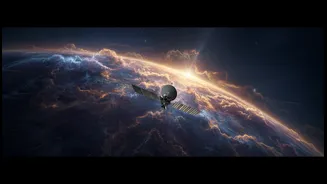
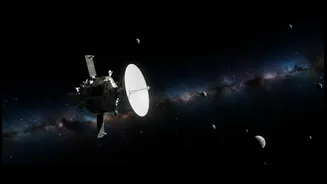
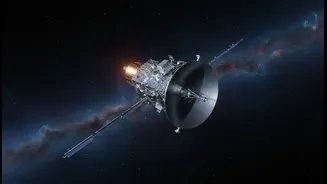


A Journey Beyond Pluto
Many remember the stunning, high-resolution images of Pluto that New Horizons sent back in 2015, revealing the dwarf planet's heart-shaped glacier and complex terrain. Four years later, it studied Arrokoth, the most distant object ever explored up close.
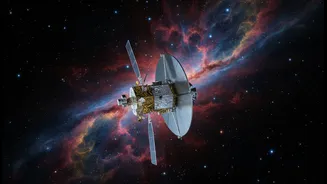
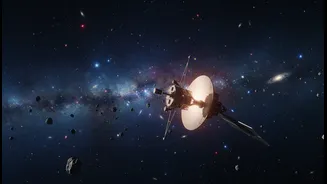
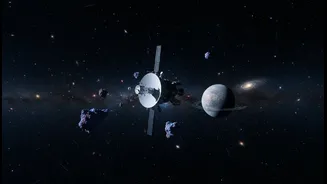
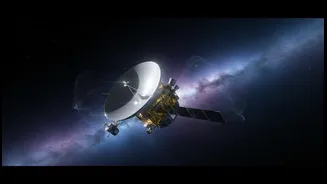
But its mission was far from over. Today, New Horizons serves as a deep-space observatory, journeying through the Kuiper Belt, a vast ring of icy bodies beyond Neptune. As of July 2026, the spacecraft is approximately 9.5 billion kilometers from Earth and just woke up from a 321-day hibernation period to continue its work. It is now speeding towards its next frontier: the very edge of the sun's influence.
The Sun's Protective Bubble
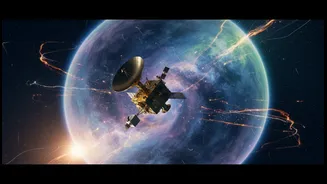
Our solar system exists inside a giant bubble called the heliosphere. This bubble is created by the solar wind, a constant stream of charged particles flowing outward from the sun at about 400 kilometers per second. This wind travels unimpeded for billions of kilometers, pushing back against the interstellar medium—the sparse gas and dust that fills the space between stars. The heliosphere acts as a crucial shield, protecting the planets, including Earth, from a significant amount of high-energy cosmic radiation. But this bubble doesn't extend forever. At a certain point, the solar wind is no longer strong enough to push back the pressure of interstellar space.
Approaching the Termination Shock
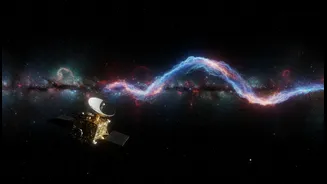
The boundary New Horizons is heading toward is known as the "termination shock." This is the point where the solar wind, after its long journey from the sun, abruptly slows down from supersonic to subsonic speeds. You can see a similar effect when tap water hits the bottom of a sink and spreads out rapidly before forming a small 'wall' of water where it slows down. For the solar wind, this slowdown causes it to become compressed, hotter, and more turbulent. It’s not a clean line but a dynamic, rippling frontier that expands and contracts. Scientists predict New Horizons will reach this region sometime around 2028 or 2029 as it continues to exit the Kuiper Belt.
Following in Legendary Footsteps
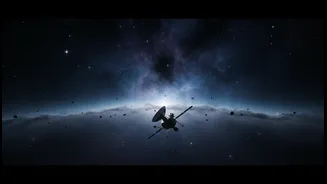
Only a handful of human-made objects have ever reached this far, and only two are still operating there: NASA’s legendary Voyager 1 and Voyager 2 probes. Voyager 1 crossed the termination shock in 2004, and Voyager 2 followed in 2007. Their data revealed that the heliosphere isn't perfectly round but is somewhat 'squashed' or asymmetrical, as Voyager 2 hit the boundary about 1.6 billion kilometers closer to the sun than its twin did. Both Voyager probes have since passed the next boundary, the heliopause, and entered true interstellar space, sending back unprecedented data about the environment outside our solar bubble. The Pioneer 10 and 11 probes also crossed into this region but are no longer operational.
What Scientists Hope to Learn
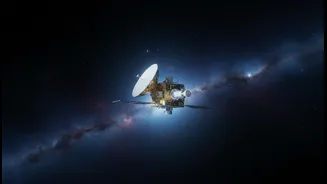
While the Voyagers were pioneers, New Horizons carries a more modern and sophisticated suite of scientific instruments. Its plasma and dust sensors have been collecting data continuously, even during hibernation, providing a unique look at the outer heliosphere. By studying how the solar wind changes as it approaches the termination shock, scientists can better map the structure of our solar system's edge. New Horizons can provide higher-resolution data on the particles and magnetic fields than its predecessors. These observations will help us understand the complex interactions between the sun's influence and the galaxy beyond, a critical step in understanding our place in the cosmos and planning for future interstellar exploration.