





What Exactly Is Nordic Walking?
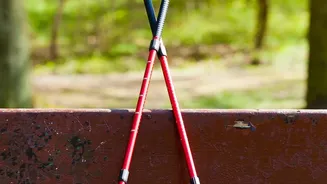
Originating in Finland as a summer training method for cross-country skiers, Nordic walking is a low-impact exercise that involves walking with specially designed poles. Unlike regular trekking poles used for stability on hikes, these poles are used to
propel you forward. By actively pushing off with the poles, you engage your upper body in a way that regular walking does not. This transforms a lower-body exercise into a comprehensive workout that utilizes up to 90% of your body's muscles, compared to about 50% for standard walking.
The Full-Body Benefit
The core advantage of Nordic walking is its ability to provide a full-body workout. While your legs do the walking, the poles ensure your arms, chest, back, and core muscles are actively engaged. Pushing the poles works your triceps, latissimus dorsi (lats), and pectoral muscles. This increased muscle activation leads to a higher heart rate and can burn up to 20% more calories than walking at the same pace without poles. Furthermore, the technique helps distribute the physical load across the entire body, reducing stress on joints like the knees and hips, which makes it an excellent choice for individuals seeking a low-impact activity.
Assess Your Balance and Conditioning
Before you begin, it is important to honestly assess your current physical state. Are you new to regular exercise and concerned about stability? Or are you a conditioned walker looking for a new challenge? For those concerned with balance, Nordic walking offers built-in support. The two poles provide additional points of contact with the ground, which significantly improves stability and can reduce the risk of falls. If your conditioning is low, the key is to start slow on flat, even surfaces like a local park path or sidewalk. If you are already fit, you can begin on more varied terrain to challenge your body from day one.
Scaling for Your Fitness Level
Nordic walking is highly adaptable. For beginners or those with balance concerns, the focus should be on proper technique and stability. Start with shorter walks of 20-30 minutes, keeping a steady, comfortable pace on flat ground. Use the poles to maintain balance and rhythm. As your confidence and conditioning improve, you can increase the intensity. Walk for longer durations, increase your speed, or incorporate hills and varied trails. This progression ensures you are continuously challenging your cardiovascular system and muscles. For an advanced workout, you can even try intervals of fast-paced walking followed by recovery periods.
Mastering the Basic Technique
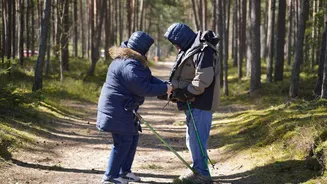
Proper technique is crucial to unlock the full benefits. Stand tall with a slight forward lean from the ankles, keeping your shoulders relaxed. The basic movement involves an opposite arm and leg motion, just like regular walking. As your left leg steps forward, your right arm swings forward to plant the pole. As the pole swings back, open your hand to release the grip slightly. The pole should be planted at an angle behind your body to propel you forward. This rhythmic, flowing motion is what engages the upper body and core. Many beginners find it helpful to watch instructional videos or join a local group to learn the correct form from an experienced walker.