




A Groundbreaking Martian Weather Report
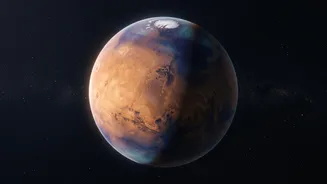
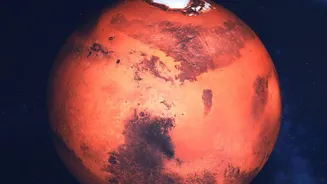
Scientists from the prestigious Physical Research Laboratory (PRL) in Ahmedabad have published new research that provides one of the most detailed looks yet at the climate dynamics of Mars. Their study, focusing on two massive impact basins named Hellas
and Argyre, reveals just how extreme the planet's temperatures can be. The team found that surface temperatures can plummet to a bone-chilling -113 degrees Celsius in winter and rise to a relatively mild 27 degrees Celsius in the summer. These dramatic shifts are largely due to Mars' incredibly thin atmosphere, which is about 100 times less dense than Earth's and struggles to hold onto heat. As a result, the surface warms up rapidly in sunlight and loses that heat almost instantly after sunset.
The Planet's Wonky Orbit
Adding to the temperature extremes is Mars's elliptical orbit around the Sun. Unlike Earth's nearly circular path, Mars's orbit is more of an oval. This means that during the southern hemisphere's summer, the planet is significantly closer to the Sun. This proximity makes southern summers on Mars far more intense, with temperatures in some regions about 25 Kelvin higher than during the northern summer. But the PRL scientists discovered that the story wasn't just about seasonal highs and lows. They found that the planet's temperature changes are not uniform; instead, they move in large, structured patterns across the surface. This is where the story of zonal waves begins.
So, What Are Zonal Waves?
Think of zonal waves as giant ripples in a planet's atmosphere that move along lines of latitude. On Earth, these planetary-scale waves, sometimes called Rossby waves, influence the path of jet streams and can lead to stable weather periods or extreme events. On Mars, these waves are a vital clue to understanding how its thin atmosphere circulates. The Indian researchers found that by tracking these temperature waves, they could indirectly map the movement of the Martian atmosphere, much like watching ripples on a pond to understand the currents flowing beneath the surface. The team observed distinct wave patterns in the two basins they studied. The Argyre basin was dominated by a simple, large-scale 'wave-1' pattern, while the deeper Hellas basin showed more complex 'wave-2' and 'wave-3' patterns, suggesting its unique topography plays a major role in shaping atmospheric flow.
India's Contribution to Global Science
This significant discovery was made possible by analysing data from an international mission. The Ahmedabad-based team used observations from the Emirates Mars Infrared Spectrometer (EMIRS), an instrument aboard the United Arab Emirates' Hope spacecraft. This collaboration highlights a growing trend in space science where data from one nation's mission can be leveraged by scientists around the world to produce breakthrough findings. The study, published in the journal Current Science, not only showcases the analytical prowess of Indian planetary scientists but also refines existing climate models of Mars. The researchers noted that their real-world observations showed temperatures about 10 Kelvin warmer than what leading climate models had predicted, a crucial finding that will help improve the accuracy of future Martian weather forecasts.
Why This Research Matters
Mapping Mars's climate isn't just an academic exercise. As humanity sets its sights on future robotic and, eventually, crewed missions to the Red Planet, a deep understanding of its weather is critical. Knowing how and where temperatures can swing by over 100 degrees Celsius is essential for designing landers, habitats, and equipment that can survive the harsh environment. Furthermore, understanding the atmospheric dynamics, including how dust is transported by winds, is vital for mission safety and success. This research from the Physical Research Laboratory provides another crucial piece of the puzzle, helping us better comprehend Mars's past, predict its future, and plan for our arrival. It's a powerful demonstration of how observing our planetary neighbours helps us write the next chapter in the story of space exploration.