







A Universal Language of Song
From the intricate melody of a nightingale to the simple whistle of a wood-pewee, the diversity of birdsong across the globe is astonishing. For centuries, we have been captivated by these sounds, but understanding the rules that govern them has been a monumental
challenge. Recently, a major study has revealed something remarkable: the songs of most perching birds, which make up over 60% of all bird species, are constructed from just eight fundamental building blocks. This discovery simplifies the daunting complexity of birdsong into a manageable framework, much like identifying the primary colors that painters use to create an infinite spectrum of art. This new model doesn't just help us appreciate the music; it provides a powerful analytical tool to decode what birds are communicating and how their songs have been shaped by their environments and evolutionary past.
The Eight Building Blocks
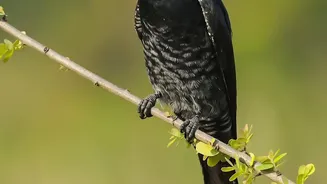
Researchers, using machine learning to analyze over 116,000 songs from more than 3,000 species, identified eight core acoustic motifs. These are the fundamental units that birds mix and match to create their unique repertoires. The eight motifs identified are: slow, fast, and ultrafast trills; flat, slow-modulated, and fast-modulated whistles; harmonic stacks; and chaotic notes. Think of the Eastern Wood-Pewee's plaintive, curving "pee-ah-wee" as a classic slow-modulated whistle, while the rapid-fire, high-pitched song of a Bohemian Waxwing is a prime example of an ultrafast trill. The study found that while the global variety of song is immense, almost all of it can be deconstructed into combinations of these eight elements. On average, a single species uses about five of these motifs in its vocal arsenal, often favoring one dominant type but blending others to add complexity.
A New Lens for Ecology
This model does more than just categorize sounds; it provides critical insights into how ecology shapes behavior. The study found strong links between the types of motifs a bird uses and its habitat. For example, flat whistles, which are simple, single-note sounds, are more common in dense tropical rainforests. The physics of sound explains why: these simple frequencies travel more effectively through thick vegetation without getting distorted. In contrast, complex and rapid motifs like ultrafast trills are more prevalent in temperate regions with more open landscapes and shorter, more intense breeding seasons. In these environments, birds may need to pack more information into their songs to communicate quickly and effectively over shorter distances. By analyzing a bird's song, ecologists can gather clues about the pressures of its environment without ever leaving the lab.
Tracing Evolutionary Footprints
The model also serves as a powerful tool for evolutionary biologists. The eight motifs appear to have evolved very early in the history of songbirds and have been adapted and reused countless times across different species. By comparing how different species combine these acoustic building blocks, scientists can explore the evolutionary relationships between them. It’s similar to how geneticists compare DNA sequences to build a family tree. This acoustic-based approach offers a new way to understand how new species arise and how their communication systems diverge over time. For example, two closely related species might use very similar sets of motifs, while more distantly related birds have developed entirely different sonic signatures, even if they are built from the same basic parts.
The Future of Bioacoustics
The framework provided by the eight-part model represents a significant leap forward in the field of bioacoustics. By standardizing the way we describe and analyze birdsong, it allows for large-scale, global comparisons that were previously impossible. This approach isn't limited to birds. Researchers suggest that similar models could be developed to study the complex vocalizations of other animals, from the croaks of frogs to the clicks and whistles of dolphins and whales. The ability to use massive datasets from community science platforms like iNaturalist and xeno-canto was crucial to this discovery, highlighting the growing power of combining citizen science with artificial intelligence to probe the mysteries of the natural world.