




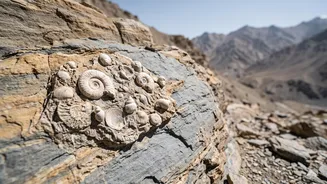
A Seafloor in the Sky
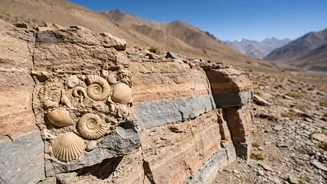
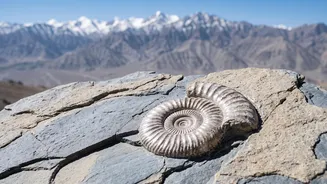
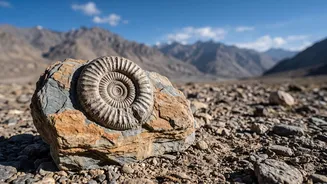
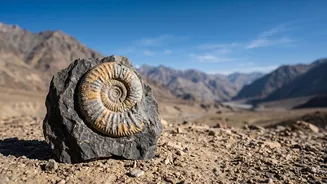
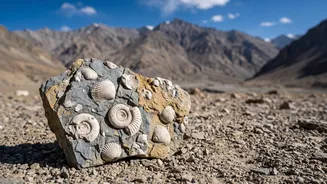
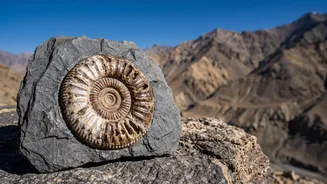
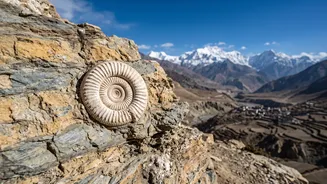
Geologist Dr. Ritesh Arya, founder of the Tethys Fossil Museum, recently discovered a remarkable collection of marine fossils in the Changthang region of eastern Ladakh. The site at Nyoma, now a cold, arid landscape thousands of metres above sea level,
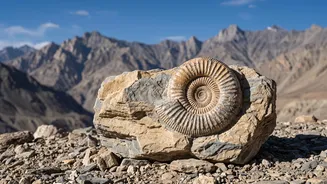
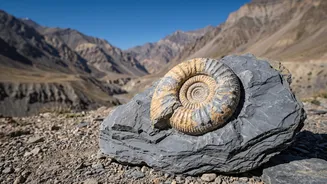
yielded a trove of specimens estimated to be between 34 and 38 million years old. The collection is dominated by spiral-shaped gastropods (Turritella-type), along with bivalves and oyster-like forms that once thrived on an ancient seabed. This discovery builds on preliminary findings Dr. Arya first presented in 2018, but the new, larger collection provides a much clearer picture of Ladakh's ancient environment. For a region now defined by barren mountains, these fossils preserve the memory of a completely different world.
Echoes of the Lost Tethys Ocean
The existence of marine fossils in the Himalayas is not new, with evidence even found near the summit of Mount Everest. These discoveries confirm that the entire Himalayan range was once the floor of the Tethys Ocean, a vast body of water that separated the ancient Indian and Eurasian landmasses millions of years ago. As the Indian tectonic plate drifted north and collided with the Eurasian plate, the immense pressure uplifted the seafloor. Sediments that had accumulated for eons, containing the remains of countless sea creatures, were scraped off, folded, and thrust upwards to form the world's highest mountain range. The Nyoma fossils are a tangible link to this lost ocean, providing a snapshot of the life that existed just before the final continental collision.
A Warm, Coastal Environment
The fossils from Nyoma tell a very different story of Ladakh. The presence of these specific marine shells, along with other documented finds in the area like fossil palms, petrified wood, and traces of burrowing organisms, points to a warm, near-coastal environment during the Eocene epoch. This was not a deep, dark abyss but likely a shallow sea fringed by subtropical vegetation, a stark contrast to the cold desert of today. Dr. Arya noted that the fossils look remarkably similar to those found in the Subathu Formation, a well-known geological layer in the outer Himalayas. This similarity is the discovery's most crucial aspect.
Rewriting Geological Maps
The key scientific question raised by the Nyoma find is its connection to the Subathu marine system. Until now, the eastern extent of this ancient sea was not well understood. If detailed analysis confirms that the Nyoma fossils are indeed part of the same system, it would mean the Eocene sea extended much farther into the Ladakh corridor than previously recognised. This could reshape our understanding of Himalayan paleogeography, offering critical data on the final stages of the Tethys Ocean before it was squeezed out of existence by the colliding continents. The specimens are now undergoing detailed study to confirm their precise age and relationship with other Himalayan formations, a process that could add a vital new piece to the puzzle of the Himalayas' geological evolution.