

A Tale of Two Twins
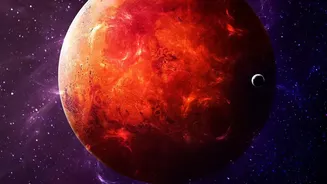
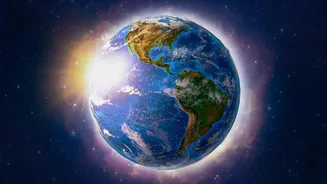
Venus is often called Earth’s twin. The two planets are remarkably similar in size, mass, and composition, leading scientists to wonder why their paths diverged so radically. While Earth is a cradle of life, Venus is a scorching hothouse with surface
temperatures that can melt lead. One of the most glaring differences, however, is that Earth has a large, stable moon while Venus has none. For decades, astronomers have puzzled over this absence. Did Venus never form a moon in the chaotic early days of the solar system? Or was a potential moon obliterated by a later, catastrophic impact? A recent study led by astrophysicist Stephen Kane at the University of California, Riverside, proposes a third, more intimate possibility: Venus may have been its own moon’s undoing.
The Physics of Planetary Spin
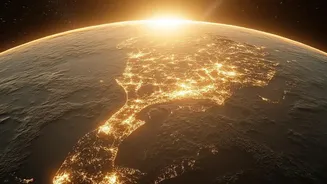
The fate of a moon is locked in a gravitational dance with its planet, and the speed of the planet’s rotation is the music. Earth completes a rotation every 24 hours. This relatively fast spin transfers rotational energy to our Moon, causing it to drift away from us at a rate of about four centimetres each year. We know this with certainty thanks to mirrors left on the lunar surface by Apollo astronauts. Venus tells a completely different story. It is the solar system’s slowest rotator, taking an incredible 243 Earth days to complete a single turn. According to the new simulations, this sluggish spin reverses the tidal interaction. Instead of pushing a moon away, the planet’s gravity would relentlessly pull it inward.
Simulating a Cosmic Collision
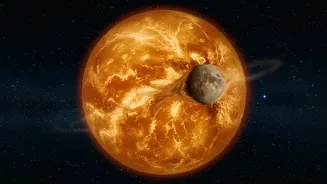
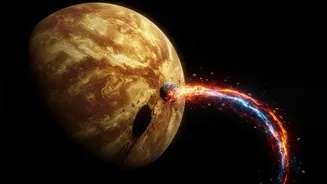
To test this theory, Kane and his team ran a series of computer simulations. They modelled a hypothetical Venus-moon system under various conditions, adjusting the planet's initial rotation speed and the size of its satellite. The results were stark. In the vast majority of scenarios, the moon was doomed. Instead of migrating to a safe distance, the simulated moon would lose orbital energy and begin a long, slow spiral toward the planet, eventually either being torn apart or crashing directly into Venus. The simulations suggest that the more massive a moon was, the faster its demise. Depending on the starting conditions, this entire process could have concluded in as little as a few tens of millions of years—a brief moment in cosmic time.
A World Reshaped by a Lost Moon
The study does not definitively prove that Venus ever had a moon, but it strongly suggests that if one ever formed, its survival would have been highly unlikely. This theory provides a natural explanation for the planet’s moonless state without needing a second, external catastrophe. The implications of such a collision are enormous. An impact of that scale would have delivered a massive amount of energy into Venus, potentially reshaping its geology and fundamentally altering its climate. Some scientists speculate that such an event could have contributed to the planet’s runaway greenhouse effect, boiling away any early oceans and turning our planetary twin into the inhospitable world we see today.
The Search for Buried Evidence
Finding a smoking gun for this ancient cosmic crash is incredibly challenging. Venus underwent a massive global resurfacing event around a billion years ago, essentially paving over its older crust and erasing any surface craters or scars from such a collision. However, evidence might still be hidden. Scientists on Earth have found seismic evidence deep within our planet’s mantle that may be the remnants of the ancient impactor that created our own Moon. Future missions to Venus, like NASA's planned DAVINCI probe, could potentially detect chemical anomalies in the atmosphere or use seismic data to hunt for similar structures buried deep beneath the Venusian surface, offering tantalising clues about a ghost that may still haunt the planet.