






Anatomy of a Micro-Impact
For centuries, we’ve understood that dripping water can wear away stone. Yet, the precise mechanics remained surprisingly mysterious. A recent study from Swiss researchers has provided a new level of detail. Using high-speed cameras to analyse simulated
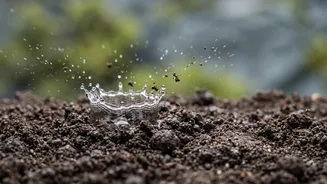
raindrops hitting a sandy slope, they discovered something missed by previous models. Instead of a simple splash, the drops deformed into complex peanut- and doughnut-shaped forms upon impact. This deformation allowed a single drop to scoop up and carry away far more sand than was thought possible. This process, known as splash erosion, is the very first step in the massive chain reaction of water erosion, where the kinetic energy of a single raindrop dislodges soil particles, making them available to be washed away.
The Shockwave in a Droplet
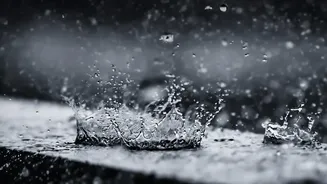
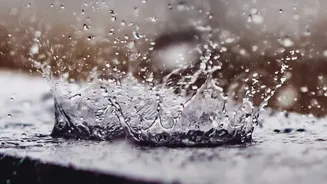
If the shape-shifting is the 'what', then other research helps explain the 'how'. Scientists from the University of Minnesota uncovered the incredible force packed into each tiny projectile. Their work showed that a liquid droplet hitting a surface doesn't just push against it; it behaves like a tiny bomb, releasing its energy explosively. Their groundbreaking technique, called high-speed stress microscopy, allowed them to measure the pressure underneath the impact. They found that as the droplet spreads out, its edge can briefly move faster than the speed of sound, creating a miniature shock wave that blasts away at the surface. This immense, instantaneous pressure helps explain why something as seemingly soft as water can, with enough persistence, break down solid rock.
From a Grain of Sand to the Himalayas
These micro-events have macro consequences of a truly epic scale. When you multiply that tiny impact force by trillions of raindrops over millions of years, you get the power to move mountains—literally. Research focused on the Himalayas has shown a direct link between the intensity of monsoon rainfall and the rate of erosion. This erosion by rivers, which starts with the dislodging of particles by raindrops, carves into the rock, steepening the valleys. In a fascinating geological feedback loop, this rapid removal of material can actually reduce the weight on the underlying crust, allowing the mountain range to be pushed up even faster by tectonic forces. In this sense, rain doesn’t just wear mountains down; it helps build them up.
A Complicated Relationship
However, the connection between rainfall and erosion isn't a simple case of 'more rain equals more erosion'. A 2026 study introduced the concept of 'erosion saturation'. It suggests that landscapes have an intrinsic response time. If climate patterns change slowly, the landscape adjusts. But if rainfall increases too rapidly, the system can become saturated. The rivers and slopes can only move so much sediment at once. This means that beyond a certain point, additional rainfall doesn't lead to a proportional increase in erosion. This adds a crucial layer of complexity, showing that our planet's systems have built-in limits and buffers that we are only just beginning to understand.
Weathering a Changing Climate
This new understanding is especially critical in the face of climate change. A warmer atmosphere holds more moisture, leading to more frequent and intense extreme precipitation events across the globe. As human activities continue to warm the planet, we are fundamentally altering the patterns of this powerful erosive force. For India, which is heavily influenced by the annual monsoon, the implications are profound. Changes in monsoon intensity and duration could dramatically alter erosion rates, impacting everything from agricultural soil fertility to the stability of Himalayan slopes. This makes understanding the fundamental physics of a single raindrop an urgent priority for predicting the future of our landscapes.