




Meet the Lion Nebula
The Lion Nebula, officially known as NGC 2392, isn't a place where new stars are being born, but rather a stunning monument to a star's death. Located thousands of light-years from Earth, it's what astronomers call a planetary nebula. This can be a confusing
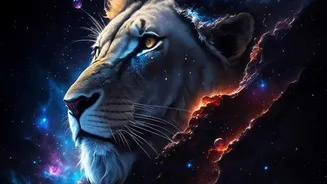
name, as it has nothing to do with planets. Instead, it’s the glowing, expanding shell of gas and dust shed by a star similar to our Sun as it reached the end of its life. For thousands of years, this material has been spreading out into space, sculpted by the intense radiation and stellar winds from the dying star at its center. The nebula gets its popular nickname from its appearance, which some observers think resembles the face and flowing mane of a lion.
A New Look from an Infrared Eye
While the Hubble Space Telescope gave us beautiful views of the Lion Nebula in visible light, the James Webb Space Telescope (JWST) sees the universe differently. Webb is designed to detect infrared light, which is invisible to the human eye. This allows it to peer through obscuring layers of cosmic dust that would block visible light, much like how infrared goggles can see through smoke. By capturing the nebula in both near- and mid-infrared wavelengths, Webb has produced a much sharper, more detailed portrait. These new observations highlight features that were previously faint or hidden, giving scientists an unprecedented look at the complex environment created by the dying star.
Filaments of Cosmic Dust
The most striking new details are the intricate filaments and clumps of fine dust that make up the lion's 'mane'. This dust is not like the kind you find in your home; it's often made of complex carbon-based molecules, sometimes called polycyclic aromatic hydrocarbons (PAHs), or silicates. In the harsh environment of the nebula, a fierce wind of particles and radiation flows outward from the central star. This blast carves out a bubble of superheated gas that forms the 'face' of the lion, destroying some of the dust in its path. However, Webb's images clearly show that some dense filaments of dust are tough enough to survive this onslaught. These resilient clumps act like shields, protecting the material behind them and creating long, comet-like tails that stream away from the star.
A Story Written in Starlight
These fine dust structures are more than just a pretty picture; they are a physical record of the nebula's history and evolution. By studying their shape, density, and composition, astronomers can piece together the story of how the star died. The filaments and shells reveal how the star ejected its outer layers in successive waves and how its powerful stellar winds are now interacting with that material. The ability of dust to survive and even form in such extreme environments is a key area of study for Webb. These observations provide a 'snapshot' in time of a process that unfolds over millennia. Astronomers can use this information to test and refine their models of how stars like our own Sun will evolve and eventually enrich the galaxy with new elements.
Why This Cosmic Detective Work Matters
Studying planetary nebulae like the Lion Nebula helps us understand the cosmic life cycle. Most stars in the universe, including our Sun, will one day end their lives in a similar fashion. The process enriches the interstellar medium—the vast space between stars—with heavier elements and complex molecules forged inside the star. This material, including the very dust grains Webb has observed, becomes the raw ingredient for future generations of stars and, eventually, new planets. By seeing these intricate dust structures with such clarity, we are essentially watching the galaxy recycle itself. Each new image from Webb offers another piece of the puzzle, bringing us closer to understanding our own cosmic origins and the universe's grand, ongoing story of creation.