




The Moon's Navigation Challenge
For decades, navigating in lunar space has been a complex, Earth-dependent task. Spacecraft have to "phone home," communicating with large, ground-based antennas like the Deep Space Network to figure out their precise location. This process is slow, cumbersome,
and expensive, creating a bottleneck for real-time operations. For astronauts on the surface during the Apollo missions, navigation involved star charts and recognising landmarks, backed by constant communication with Mission Control. As NASA plans for a sustained human presence on the Moon with its Artemis program, including a future base camp, this old method simply won't be fast or reliable enough for complex construction, rover traverses, and ensuring astronaut safety far from the landing site.
A GPS for the Moon
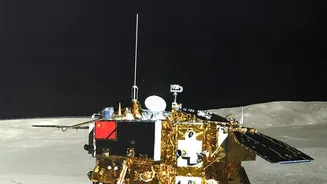
To solve this, NASA is pioneering a new approach: using the same Global Navigation Satellite System (GNSS) signals—the technology behind the GPS on your phone—to navigate at the Moon. This might sound strange, since GPS satellites are designed to blanket the Earth, not deep space. However, their signals don't just stop; weaker signals, known as side lobes, spill out into space. NASA engineers have developed highly sensitive receivers, like the one tested in the Lunar GNSS Receiver Experiment (LuGRE), that are capable of detecting these faint signals from 400,000 kilometres away. This experiment, a collaboration with the Italian Space Agency, successfully demonstrated that it is possible to get a position fix on the Moon using Earth's GPS and Galileo constellations, proving the concept works.
Enter LunaNet: An Internet for the Moon
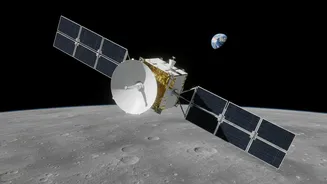
Receiving Earth's GNSS signals is just the first step. The ultimate vision is a comprehensive, scalable framework called LunaNet. Think of it as an internet and GPS service rolled into one, specifically for the Moon and the space around it. LunaNet will be a network of networks, combining various assets—orbiting satellites, landers, and even surface beacons—to provide seamless communication and navigation services. This will allow missions, whether from NASA, international partners like the ESA, or commercial companies, to plug into a shared infrastructure. A lander, a rover, and an astronaut could all know their precise locations in real-time and communicate with each other, without having to relay every single piece of data through Earth.
Unlocking True Lunar Autonomy
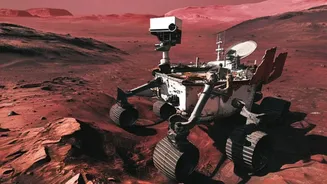
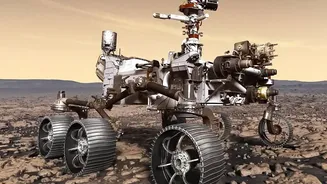
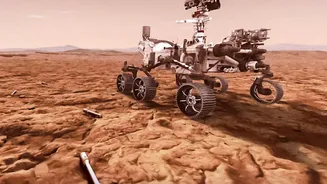
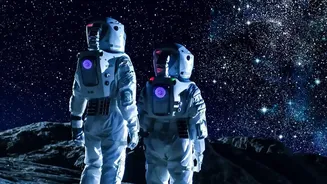
This is where autonomous travel becomes a reality. With a reliable, real-time navigation system, rovers can traverse long distances without step-by-step guidance from a human operator on Earth. Astronauts exploring on foot or in a vehicle can navigate treacherous terrain with the confidence of a digital map showing their exact position, even in the confusing, long shadows of the lunar poles. Autonomous systems can handle complex rendezvous and docking manoeuvres in lunar orbit with greater precision and safety. This shift drastically reduces the reliance on mission control, freeing up resources and allowing explorers on the Moon to make faster, more independent decisions. It's the difference between being remotely controlled and being truly present and in command of your environment.
What This Means for the Future
The development of an autonomous lunar navigation system is a critical enabler for the entire future of space exploration. For the Artemis program, it means building and operating a permanent lunar base becomes far more feasible. For commercial companies planning to deliver cargo or conduct mining operations, it provides essential infrastructure that lowers the barrier to entry. Beyond navigation, LunaNet will also provide alerts for space weather events and a search-and-rescue capability for astronauts in distress, vastly improving safety. Ultimately, the technologies and standards being developed for LunaNet will serve as a blueprint for future networks around other celestial bodies, like Mars, creating a true interplanetary internet. This is the foundational work that turns science fiction into a practical roadmap for humanity's expansion into the solar system.