






More Than Just a Practice Run
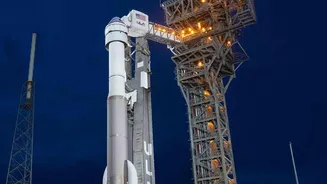
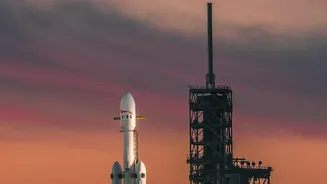
On Tuesday, September 29, the four astronauts of the Crew-13 mission participated in a crucial pre-launch milestone: the countdown dress rehearsal. This wasn't just a simple walkthrough. The crew, consisting of NASA astronauts Jessica Watkins and Luke
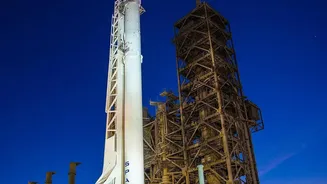
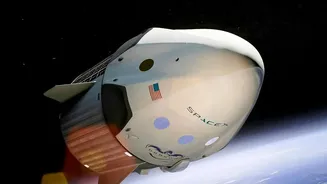
Delaney, Canadian Space Agency astronaut Joshua Kutryk, and Roscosmos cosmonaut Sergey Teteryatnikov, donned their sleek, custom-fitted spacesuits and traveled to the launch pad at Cape Canaveral Space Force Station. There, they boarded the SpaceX Dragon capsule, named 'Grace', perched atop a powerful Falcon 9 rocket. While the astronauts were inside, the launch teams from NASA and SpaceX simulated the entire countdown process, a meticulous sequence of events that has to run perfectly on launch day. This procedure is a cornerstone of the Commercial Crew Program, a partnership where NASA leverages private industry innovation from companies like SpaceX to transport astronauts to and from the International Space Station (ISS).
The Purpose of the Rehearsal
The primary goal of such a rehearsal is to flush out any hidden issues. These can range from software glitches and communication link dropouts to mechanical problems with ground equipment or the rocket itself. For some missions, this includes a “wet dress rehearsal,” where the rocket is fully loaded with cryogenic propellants to check for leaks and test the fueling systems under launch-day conditions. In this high-stakes environment, finding a problem on the ground is considered a success, not a failure. It provides engineers with a vital opportunity to fix issues safely, ensuring that when the real countdown begins, every system has been double and triple-checked. The rehearsal validates the complex interplay between the flight crew, the spacecraft, and the hundreds of personnel in the launch control center.
Meet the International Crew-13
The four-person crew represents a global collaboration in space exploration. The mission is commanded by NASA's Jessica Watkins, a geologist who is making history as the first NASA astronaut to fly on a SpaceX Dragon for a second time. She is joined by pilot Luke Delaney, a former naval aviator and NASA rookie. The crew also includes two mission specialists on their first spaceflights: Joshua Kutryk, a fighter pilot from the Canadian Space Agency, and Sergey Teteryatnikov, a former submariner from the Russian space agency Roscosmos. Together, they will join the Expedition 75 crew aboard the ISS for a mission expected to last around six months.
A Mission of Science and Discovery
Once aboard the orbiting laboratory, the Crew-13 astronauts will be busy with hundreds of scientific investigations and technology demonstrations. Their work will support a wide range of fields, from biomanufacturing to materials science. Experiments will include studying how human stem-cell tissues behave in microgravity to potentially advance treatments for diseases like Parkinson's on Earth. The crew will also conduct research into in-space food production, a critical technology for future long-duration missions to the Moon and Mars. These experiments not only push the boundaries of human exploration but also deliver tangible benefits back on our planet.
What Happens Next?
With the dress rehearsal complete and the subsequent Flight Readiness Review giving the 'go' for launch, all eyes are now on the sky. The mission is scheduled to lift off at 11:10 a.m. EDT on Thursday, October 1. Weather is always a significant factor, with officials from the U.S. Space Force's 45th Weather Squadron providing constant updates on conditions. If all goes as planned, the Dragon spacecraft could complete its journey to the ISS in just under eight hours, potentially setting a new record for the fastest U.S. crewed trip to the station. After docking, the Crew-13 astronauts will be welcomed aboard by the departing Crew-12 members for a brief handover before beginning their long-duration stay in orbit.