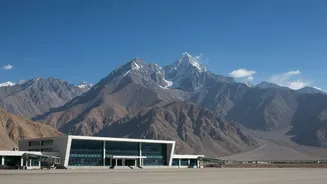









A Breathtaking Arrival
Flying into Leh is a unique spectacle. Passengers are treated to stunning views of the Himalayan peaks as the aircraft navigates through the mountainous terrain for its approach. The airport, officially named Kushok Bakula Rimpochee Airport, serves as the primary
air gateway to the Ladakh region. It is a dual-use airport, meaning it serves both civilian passengers and the Indian Air Force, making it a facility of immense strategic value. Due to strong mountain winds that pick up in the afternoon, all flight operations are famously restricted to the morning hours, adding another layer of complexity to its daily schedule.
The Challenge of Thin Air
Operating an airport at such a high altitude is a significant scientific and engineering challenge. The primary issue is the reduced air density. At 10,682 feet, the air is significantly thinner than at sea level. This has a direct impact on aircraft performance: engines produce less thrust, and wings generate less lift. As a result, planes require a longer distance to achieve takeoff speed and need higher speeds for landing. This is why runways at high-altitude airports are often longer than their sea-level counterparts to compensate for the reduced aerodynamic performance. The combination of high altitude and potentially high temperatures on warmer days, a condition known as "hot and high," further decreases air density and can place additional limits on an aircraft's weight.
An Elite Club of Pilots
Landing at Leh is not a task for every pilot. The challenging approach through a valley, the unidirectional runway, and the difficult atmospheric conditions mean that only specially trained and certified pilots are permitted to operate flights to Leh. These flight crews undergo specific training to handle the complexities of high-altitude operations, including simulated engine failures in this demanding environment. Pilots must follow very precise approach and departure procedures, using specific waypoints and adhering to strict altitude and speed restrictions to ensure safe clearance from the surrounding terrain. This specialised skill set ensures that safety remains paramount at one of the world's most challenging airports.
A Strategic and Economic Lifeline
Leh Airport is far more than just a tourist entry point; it is a critical lifeline for the entire Ladakh region. During the harsh winter months when heavy snowfall cuts off road access, the airport becomes the only reliable connection to the rest of India, enabling the transport of residents, essential supplies, and military personnel. Its strategic importance is immense, serving as a key forward base for the Indian Air Force to support troops and maintain readiness along the nation's northern borders. Economically, the airport is the backbone of Ladakh's burgeoning tourism industry, bringing in visitors who are vital to local livelihoods.
Upgrading for the Future
To meet growing demand from both tourists and strategic operations, Leh Airport is undergoing a major expansion. A new, modern terminal building is under construction, which will significantly increase passenger handling capacity. Reports from July 2026 noted that the new terminal was 83% complete. Once operational, the airport will be able to handle nearly three times its current number of flights. This expansion project, expected to be completed by August 2026, also includes features like geothermal heating and solar power, reflecting a push towards sustainability. These upgrades are set to enhance connectivity, boost the regional economy, and solidify the airport's role as a crucial hub for the future.