




More Than Just a Wish
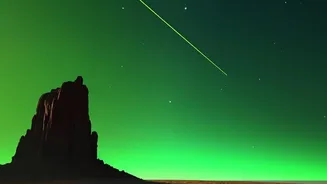
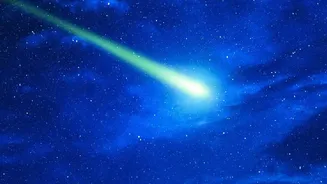
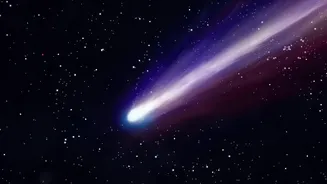
On August 3rd, NASA released a captivating image that has given stargazers and scientists alike a fresh perspective on a familiar sight. While we often think of meteors as simple flashes of light, this new photograph distinguishes the brilliant, multi-hued
glow of vaporising minerals from the typical white streak. Captured during a long exposure, the image shows a meteor that flared brightly before disappearing, leaving behind a trail of colourful gas and dust. This trail isn't just beautiful; it's a scientific fingerprint, offering clues to the meteor's composition. The image, which also features the faint red glow of the Lacerta Nebula, demonstrates the power of modern astronomy to unpack the secrets hidden within a split-second celestial event.
A Meteor’s Fiery Entrance
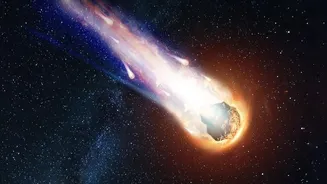
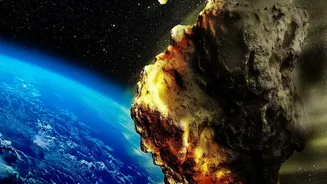
So what exactly happens when a shooting star makes its grand entrance? The spectacle begins with a meteoroid—a small piece of an asteroid or comet—speeding through space. When its path intersects with Earth's, it ploughs into our atmosphere at immense speeds, often between 30 and 70 kilometres per second. The incredible velocity compresses and superheats the air in front of the meteoroid, creating a pocket of intensely hot plasma. This extreme heat, not friction as is commonly believed, is what causes the meteoroid to vaporise and emit the brilliant flash of light we call a meteor, or shooting star. For most small meteors, this entire process is over in less than a second as they completely burn up dozens of miles above the ground.
Decoding the Cosmic Rainbow
The magic in NASA's image lies in its colours. Just like a flame test in a chemistry lab, where different chemicals burn with distinct colours, the composition of a meteoroid determines the colour of its fiery trail. As the rock and ice vaporise, their constituent elements are heated and emit light at specific wavelengths. The result is a vibrant, short-lived spectrum. An orange or yellow glow points to the presence of sodium, while a brilliant green indicates nickel or magnesium. Violet or purple hues can signify calcium, and the red glow often comes from nitrogen and oxygen in the Earth's own atmosphere being excited by the speeding particle. By analysing these colours, a technique known as spectroscopy, scientists can determine the chemical makeup of a meteoroid that is millions of miles from its origin.
Clues from Comet Swift-Tuttle
This particular meteor is likely part of the ongoing Perseid meteor shower, one of the best and brightest of the year. The Perseids are particles of dust and debris left behind by the comet 109P/Swift-Tuttle, which passes by the sun on a 133-year orbit. Each August, the Earth's orbit takes it through this trail of cosmic dust. The Perseids are known for being fast and bright, often displaying yellow and green colours due to their high nickel and magnesium content. Studying the composition of these meteors in detail, as this image allows, gives us direct insight into the composition of their parent comet. It’s like getting a sample of a distant celestial body without ever having to launch a mission to it.
Why This Science Matters
Analysing meteor composition is about more than just satisfying curiosity. These celestial visitors are remnants from the formation of our solar system. By studying their elemental makeup, scientists gain crucial insights into the building blocks of planets, including our own. NASA's All-Sky Fireball Network and experiments on the International Space Station are dedicated to this very task, using cameras to track meteors and analyse their light. Understanding the composition and trajectory of meteoroids helps scientists model the meteoroid environment, which is vital information for designing and protecting spacecraft and future missions to the Moon and beyond. Each colourful streak, therefore, is a tiny piece of a much larger puzzle about our cosmic origins and our future in space.