

Our Warped Cosmic Home
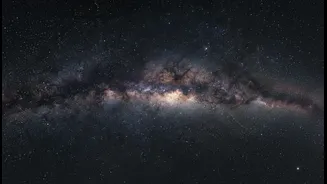
Imagine trying to figure out the shape of your city without ever leaving your house. That’s the challenge astronomers face when mapping the Milky Way from within it. For a long time, we pictured it as a majestic, flat spiral disc. But since the 1950s,
scientists have known the reality is stranger. Our galaxy is warped, with one side curving upwards and the other downwards, like a vinyl record left in the sun. This “tilt” or “warp” affects the vast disc where most of the galaxy's hundreds of billions of stars reside. For years, the cause was a mystery. Theories ranged from the influence of intergalactic magnetic fields to the gravitational pull of an unseen halo of dark matter. None of these explanations, however, fully accounted for the evidence that was slowly being gathered.
The Galactic Detective: ESA's Gaia Mission
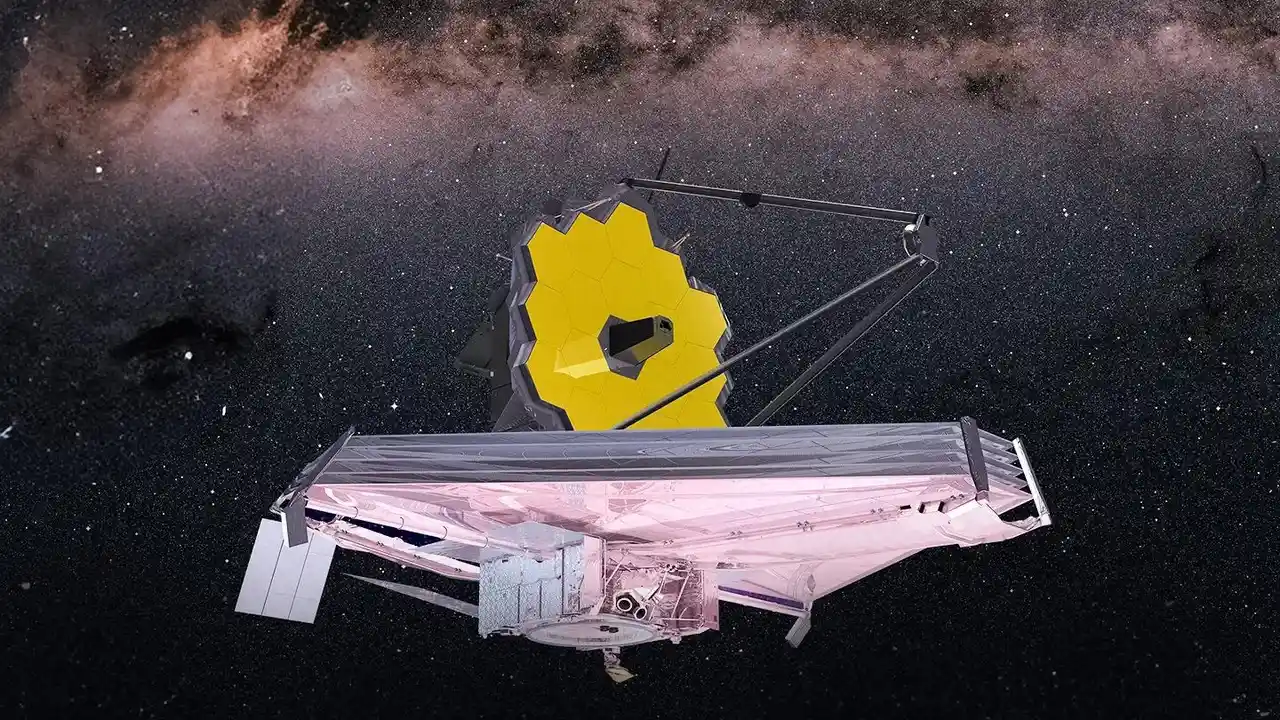
The breakthrough came from the European Space Agency's Gaia space telescope, a mission launched in 2013 with one primary goal: to create the most accurate and comprehensive 3D map of our galaxy ever made. Gaia has been meticulously charting the positions, movements, distances, and properties of nearly two billion stars. This isn't just a static map; by measuring the velocity of stars—how fast and in what direction they are moving—Gaia gives scientists the ability to create a dynamic model of the galaxy. It’s like having a traffic-flow model for the entire Milky Way, allowing astronomers to rewind the clock and see how our galaxy has evolved over billions of years.
Rewinding the Clock Reveals a Wobble
Using Gaia's precise data, scientists confirmed that the warp isn't static. Instead, it’s wobbling, or precessing, much like a spinning top. But this wobble was moving far faster than any of the existing theories could explain. The models involving dark matter or magnetic fields couldn't produce a precession this rapid. The speed of the warp's rotation, calculated to be one full circle every 600 to 700 million years, pointed to a much more powerful and dramatic cause: a direct, physical disturbance. The evidence was clear that something big had disturbed our galaxy, sending ripples through its structure like a stone tossed into a pond.
The Suspect: A Galactic Collision
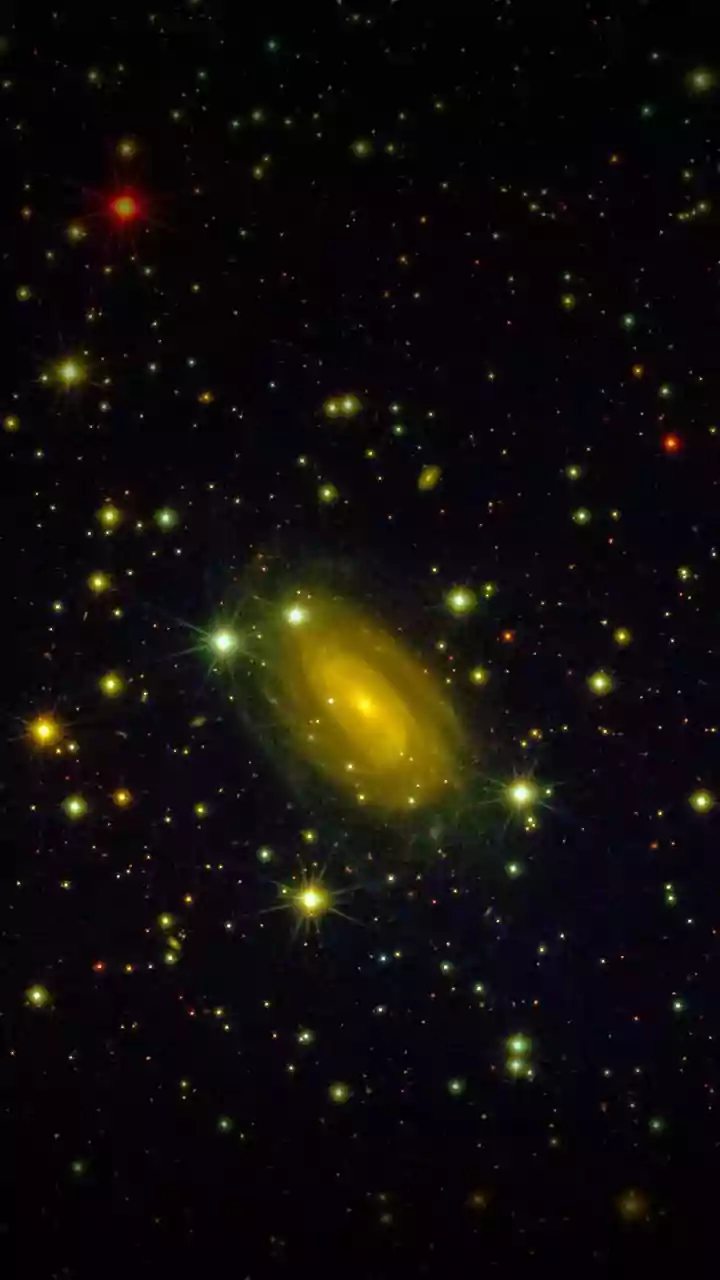
The prime suspect is the Sagittarius Dwarf Galaxy, a smaller galaxy that has been caught in the Milky Way's gravitational pull for billions of years. As it orbits our much larger galaxy, it has repeatedly smashed through the Milky Way's disc. Think of it less as a single crash and more as a series of powerful, disruptive passages. The latest research, powered by Gaia's stellar census, suggests that a collision with a satellite galaxy like Sagittarius is the most likely culprit for the warp. By feeding the observed motions of millions of stars into powerful supercomputer simulations, astronomers were able to show that a galactic collision could produce the exact kind of high-speed wobble seen today.
A Violent Past, A Vibrant Present
This cosmic history isn't just about a bent shape; it has had profound consequences for our galactic home. These repeated collisions with the Sagittarius galaxy are now believed to have triggered massive episodes of star formation. The powerful gravitational ripples from the galactic punches compressed vast clouds of gas and dust, kickstarting the birth of new stars. Incredibly, the timeline of these collisions overlaps with the formation of our own Sun. One of the first major collisions occurred around five to six billion years ago. Our Sun was born about 4.7 billion years ago, suggesting it may be a direct consequence of this violent galactic history. It’s a powerful reminder that our galaxy is not a static island but a dynamic, evolving structure shaped by cosmic encounters.