






A Mission's Enduring Legacy
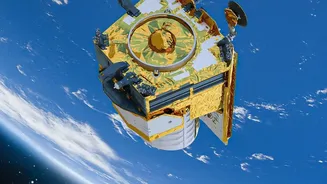
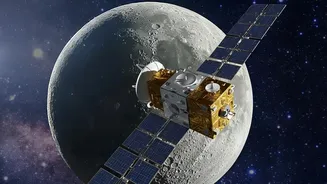
Long after its operational life concluded in 2009, India's groundbreaking Chandrayaan-1 mission is still rewriting our understanding of the Moon. In a remarkable display of scientific value, researchers from Ahmedabad's prestigious Physical Research Laboratory
(PRL) have delved back into the mission's rich archives. By re-examining data from the Moon Mineralogy Mapper (M3), an instrument aboard the spacecraft, they have uncovered what they describe as the geological 'ghost' of a massive, ancient impact crater that had previously eluded clear detection. This discovery doesn't just add a new feature to the lunar map; it underscores the immense, long-term return on investment from India’s space exploration programs. The data, gathered years ago, has proven to be a treasure trove, waiting for fresh eyes and new analytical techniques to unlock its secrets.
Finding a Crater Without a Crater
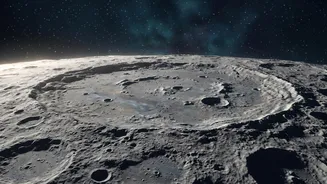
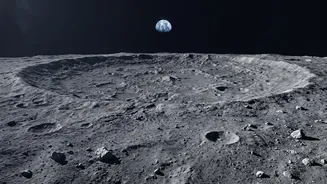
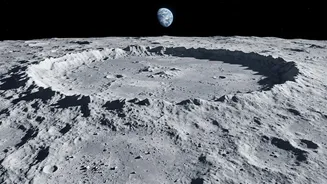
So, how do you find a basin that's been almost completely erased? The Australe Basin, located in the Moon's southeastern hemisphere, is not a feature you can easily spot with a telescope. Over billions of years, subsequent asteroid impacts, volcanic activity, and constant space weathering have worn down its original structure, flattening its rims and making it nearly invisible to traditional cameras that look for topographic shapes. The PRL scientists took a different approach, akin to cosmic forensic science. Instead of looking for the crater's physical walls, they looked for its mineralogical fingerprint. Massive impacts excavate material from deep within the lunar crust and blast it outwards in a wide ring. The team searched for specific minerals that act as a telltale sign of such an ancient, violent event.
The Telltale Mineral Evidence
The key to the discovery was a mineral called orthopyroxene. This mineral is typically found deeper within the Moon's crust and isn't common on the surface. Using the hyperspectral data from Chandrayaan-1's M3 instrument, the scientists mapped the mineral composition around the Mare Australe, or "Southern Sea". They found a broad, circular pattern of orthopyroxene-rich material that perfectly delineates the boundary of a massive, obliterated basin. This mineral ring is the smoking gun, providing the first strong spectroscopic evidence for the existence of the long-hypothesised Australe Basin, which had been suggested by earlier studies but never confirmed due to the lack of a clear topographic signature.
Why This 'Ghost' Basin Matters
Confirming the existence of the Australe Basin does more than just fill a gap on the lunar map; it helps reconstruct the Moon's violent early history. Scientists believe around 300 giant impact basins were formed on the Moon, but only about 74 have been catalogued so far. This finding helps complete that puzzle. Some research suggests the Australe Basin may even predate the South Pole-Aitken Basin, which is currently considered the largest and oldest confirmed impact structure on the Moon. If true, this would make Australe one of the earliest major impacts in lunar history, offering a window into the chaotic conditions of the early Solar System over four billion years ago. Furthermore, the unique mineralogy of the area, which is unusually low in calcium and high in magnesium, provides new clues about the composition of the Moon's mantle.
Connecting the Past to the Future
This discovery creates a fascinating link between India's past and future lunar missions. The magnesium-rich material identified as a fingerprint for the Australe Basin bears a resemblance to minerals detected by the Chandrayaan-3 rover at its landing site, Shiv Shakti Point, in 2023. This suggests that material from this ancient impact could have been thrown across vast distances of the lunar south pole. This insight is invaluable for planning future missions, particularly Chandrayaan-4, which aims to return lunar samples to Earth. Knowing where to find materials from the Moon's earliest history is crucial for selecting a landing site that can yield the most scientifically significant samples. This work by the PRL scientists demonstrates how archival data from one mission can directly inform the ground truth of another, creating a powerful cycle of discovery for India's ambitious space program.