




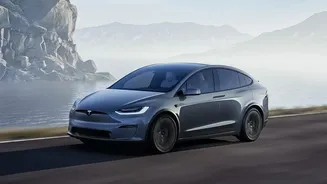
The World According to Tesla's AI
At its core, Tesla's Full Self-Driving (FSD) system is a marvel of artificial intelligence. It uses a suite of cameras to create a 360-degree view of its surroundings, feeding this visual data into powerful neural networks. These networks analyse the
raw images to understand the world, identifying everything from other cars and pedestrians to traffic lights and road signs. A critical piece of this puzzle is lane markings. For an AI trained on the relatively orderly roads of North America and Europe, painted lines are a fundamental guide, defining the vehicle's path and dictating its position relative to other traffic. The system is designed to stay within these lines, treating them as a core rule of the road. This works beautifully on well-maintained highways but becomes a significant handicap where such structure is absent.
The Unstructured Dance of Indian Roads
Anyone who has driven in India knows that traffic flow is less about rigid rules and more about fluid negotiation. Lanes, where they exist, are often treated as suggestions rather than mandates. The road is a shared space for a diverse mix of vehicles—cars, buses, auto-rickshaws, scooters, and cyclists—all moving at different speeds and often weaving through gaps. Add to this the unpredictable presence of pedestrians and stray animals, and you have a driving environment that experts describe as one of the most challenging in the world. For an AI that relies on lane discipline, this environment is a constant stream of exceptions and 'edge cases'. There are no clear lines to follow, and driver behaviour is guided by an unwritten code of eye contact, horn signals, and mutual understanding—a language that algorithms do not yet speak.
From Rigid Rules to Fluid Prediction
This is precisely why Tesla's AI must evolve beyond a dependence on fixed lanes. To operate safely and effectively in India, the system cannot simply follow pre-programmed rules. It must learn to predict. The AI needs to anticipate the intentions of a scooter driver who might suddenly cut across three lanes, understand that a bus slowing down might be dropping off passengers in the middle of the road, and recognize that the lack of a lane line doesn't mean the road has ended. This requires a shift from a deterministic model (if there is a line, follow it) to a probabilistic one (given the behaviour of all surrounding agents, what is the safest and most efficient path forward?). It's about teaching the AI the 'social physics' of Indian traffic, a task far more complex than just identifying static lines on asphalt.
The Data Dilemma and the Path Forward
The key to achieving this level of predictive intelligence is data—massive amounts of it, sourced directly from Indian roads. Tesla's strategy of 'fleet learning', where every car on the road collects data to train the central AI, is a significant advantage. However, to truly master the local context, the system must be trained extensively in the very chaos it aims to navigate. This means logging millions of kilometres in cities like Mumbai, Delhi, and Bengaluru to teach the neural networks what to expect. Competing approaches from Indian startups are already tackling this by building systems from the ground up for these conditions, sometimes using different sensor suites or reinforcement learning to model interactive road behaviour. For Tesla, solving this challenge is not merely a technical update; it's a prerequisite for market entry. The ability to handle roads without fixed lanes is the ultimate stress test, and passing it would not only unlock the vast Indian market but also create an AI robust enough to handle complex traffic anywhere in the world.