



The Beginning of the End
In the vast expanse of the cosmos, everything has a life cycle, even the colossal islands of stars we call galaxies. While some, like our own Milky Way, are still actively birthing new suns, others have entered their twilight years. This process, known
to astronomers as "quenching," is a pivotal but poorly understood phase in a galaxy's life. A recent study, leveraging the power of NASA's James Webb Space Telescope (JWST), has provided one of the clearest pictures yet of a galaxy in the midst of this quiet transformation. Astronomers have long debated why galaxies stop forming stars. This new research offers compelling evidence that helps piece together this cosmic puzzle, revealing a story of cosmic consumption and exhaustion.
Cosmic Detective Work
The focus of recent studies has been on galaxies in the early universe, a time when star formation was at its peak, an era nicknamed "Cosmic Noon." By looking deep into space, telescopes like the JWST act as time machines, showing us galaxies as they were billions of years ago. One study identified a galaxy, GS-9209, that had already stopped forming stars just over a billion years after the Big Bang. It’s a remarkable finding, showing that some galaxies lived fast and died young. The analysis suggested that a hyperactive supermassive black hole at the galaxy's center likely blasted away the gas needed for star creation. This process, called AGN feedback, is a leading theory for why massive galaxies quench.
A Tale of Two Theories
The mystery of quenching isn't a simple one, and astronomers have several competing theories. One idea is that a galaxy simply uses up all its available cold gas, the essential fuel for creating stars, in a process of gradual exhaustion. Another theory suggests a more violent end, where interactions with other galaxies play a key role. Recent research published in mid-2026 indicates that galaxy mergers can trigger a final, intense burst of star formation that consumes the gas, while the energy from the newly merged supermassive black hole then prevents any new gas from cooling down to form more stars. However, another 2026 study using vast simulations found that most mergers don't actually lead to quenching, suggesting slower, internal processes are more often the culprit. The growth of a galaxy's central black hole over time seems to be more important than a single, dramatic crash.
The Ghost in the Machine
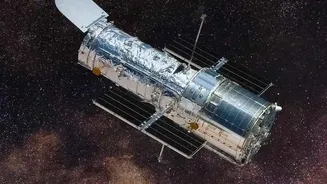
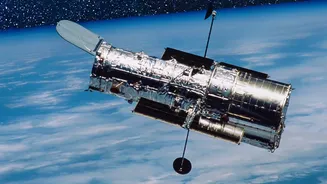
Sometimes the most active galaxies are the hardest to see. A fascinating discovery involved a galaxy named AzTECC71, which was spotted by ground-based telescopes but was completely invisible to the Hubble Space Telescope. Shrouded in a thick veil of cosmic dust, it was only with the infrared vision of the JWST that this "ghost galaxy" revealed itself. AzTECC71 was found to be a monster, forming hundreds of new stars per year about 900 million years after the Big Bang. Discoveries like this suggest that our view of the early universe has been biased, as we were missing this hidden population of extremely dusty, active galaxies that may be much more common than once thought. These are the very galaxies that might be on the verge of burning through their fuel and beginning the quenching process.
Our Galaxy's Distant Future
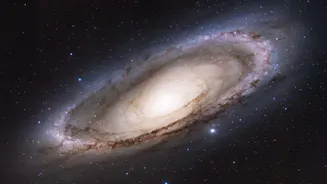
Understanding how and why other galaxies stop making stars gives us a glimpse into the potential future of our own home, the Milky Way. Our galaxy is still a lively place, but it won't be forever. Studies of our nearest large neighbor, the Andromeda galaxy, show that its star formation has been steadily declining for the past 500 million years. While the Milky Way is still active, it is destined to merge with Andromeda in about 4.5 billion years. This colossal collision will likely trigger a massive burst of star formation, followed by a long, slow decline into quiescence, much like the galaxies now being studied in the distant universe. By observing these cosmic endings, we are not just solving an astronomical mystery, but also reading a prophecy for our own galactic home, written across billions of light-years.