






The New Space Race in Low Earth Orbit
Not long ago, space was the domain of governments and a handful of large corporations. Today, Low Earth Orbit (LEO), the region up to 2,000 kilometres above us, is bustling with commercial activity. The primary drivers are mega-constellations: vast networks
of hundreds or thousands of small, mass-produced satellites working in concert. The most dominant player is SpaceX's Starlink, which alone accounts for over 11,000 of the active satellites in orbit, or roughly two out of every three. Other major projects include Eutelsat OneWeb, with over 600 satellites, and Amazon's Project Kuiper, which is in its early deployment phases. The goal of these ventures is revolutionary: to blanket the globe in high-speed internet, connecting remote and underserved communities. But this rapid expansion means the number of objects in orbit has changed more in the last six years than in the previous sixty.
Yesterday's Rules for an Emptier Sky
For decades, space operators have followed a set of informal guidelines to prevent the accumulation of space junk. The cornerstone of these has been the "25-year rule," an international guideline recommending that satellites in LEO are deorbited within 25 years of completing their mission. This was a compromise created in an era with far fewer satellites, balancing the cost of deorbiting against the risk of leaving a dead satellite lingering in a valuable orbital path. For satellites below about 600 km, atmospheric drag naturally pulls them down within that timeframe. For those higher up, it requires a deliberate, fuel-burning maneuver to lower their orbit and burn up in the atmosphere. The rule was never a binding treaty, but a shared standard for responsible behavior.
Why the Old Rules Are Breaking
The 25-year rule was not designed for an environment with tens of thousands of satellites, many with operational lifespans of only five to seven years. Leaving thousands of defunct satellites in orbit for up to 25 years is no longer a sustainable model. The sheer density of these new constellations dramatically increases the probability of collisions. Even a tiny failure rate becomes significant at this scale; a 1% failure rate for a 12,000-satellite constellation would mean 120 large, uncontrollable objects tumbling through space. In response, regulators are starting to act. The US Federal Communications Commission (FCC) has already adopted a much stricter 5-year deorbit rule for new US-licensed satellites, a direct response to the rise of mega-constellations.
The Kessler Syndrome Nightmare
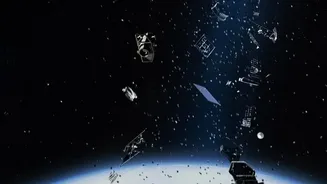
The ultimate fear among space experts is a scenario known as the Kessler Syndrome, first proposed by NASA scientist Donald Kessler in 1978. He theorized that if the density of objects in an orbit becomes too high, a single collision could create a cloud of debris. Each piece of that debris then becomes a projectile that can cause another collision, creating even more debris. This could trigger a runaway chain reaction, a cascade of destruction that renders entire orbital altitudes unusable for generations. What was once a distant theory is now an operational concern. Starlink satellites, for instance, already perform thousands of collision-avoidance maneuvers to dodge other objects. One 2009 collision between a defunct Russian satellite and an active Iridium communications satellite created over 2,000 pieces of trackable debris, a stark reminder of the risks.
The Search for Solutions
Addressing this orbital crisis requires a multi-pronged approach. Stricter, internationally recognized regulations are a clear first step, moving beyond voluntary guidelines to enforceable rules on satellite design and disposal. Beyond regulation, a new industry is emerging focused on Active Debris Removal (ADR). Companies and space agencies are developing innovative technologies like robotic arms, capture nets, harpoons, and even lasers to actively track, grab, and deorbit the most dangerous pieces of existing junk. Missions like the European Space Agency's ClearSpace-1 and Astroscale's ADRAS-J are pioneering these techniques, hoping to prove that we can clean up our orbit, not just pollute it less. Removing just five of the largest defunct objects from the most crowded orbits each year could be enough to stabilize the LEO environment.