




The Journey Across the Water
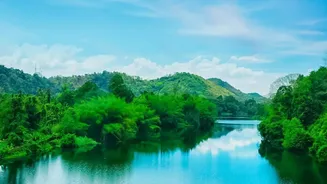
A visit to Umananda begins not on the island itself, but on the banks of the Brahmaputra in Guwahati. From Kachari Ghat, a short ten-minute ferry ride is all that separates the bustling city from this tranquil islet. The boat pushes off into the powerful
currents, and the city's skyline begins to shrink, replaced by the panoramic sweep of the river. Soon, a small, rocky hillock comes into view, crowned with the spire of a temple and fringed with trees. This is Umananda, also known as Peacock Island, a name given by a British officer who thought its shape resembled the bird's splayed feathers. As the ferry docks, the sounds of the city are replaced by the lapping of water and the distant ringing of a temple bell, marking the transition from the mundane to the mythological.
An Abode of Myth and Legend
The island's primary identity is that of a sacred site. According to Hindu mythology, Lord Shiva created this island for the happiness and pleasure of his consort, Parvati (Uma), which gives the island its name: Uma-Ananda, or 'Uma's joy'. It is also known by another, more dramatic name: Bhasmachal, meaning 'Hill of Ashes'. Legend holds that this is where Shiva, deep in meditation, was interrupted by Kamadeva, the god of love. In his anger, Shiva opened his third eye and incinerated Kamadeva on this very spot. This powerful story infuses the island with an aura of intense divine energy. A steep flight of stone steps leads from the ferry landing up to the main temple, and each step feels like an ascent into this rich mythological past.
The Umananda Devaloi Temple
At the heart of the island sits the Umananda Devaloi, a temple dedicated to Lord Shiva. Constructed in 1694 by order of the Ahom King Gadadhar Singha, the temple is a testament to the skilled craftsmanship of ancient Assamese artisans. Though it was heavily damaged in an earthquake in 1897, it was later restored by a local merchant. The stone walls are adorned with intricate carvings and sculptures depicting Ganesha, Vishnu, and other deities. Inside the modest sanctum, the atmosphere is thick with the scent of incense and the murmurs of prayer. It is not a grand, imposing structure, but one that feels deeply intertwined with the rock and soul of the island. Worshippers believe that prayers offered here on a Monday Amavasya (new moon) bring the highest bliss.
Circling a Miniature World
After visiting the temple, a walk around the island's perimeter truly brings the headline's promise to life. The path, sometimes just a narrow track winding between rocks and tamarind trees, hugs the island's edge. The walk is surprisingly short; it takes little time to circle this entire inhabited world. From one side, you have an uninterrupted view of the vast, seemingly endless Brahmaputra. From the other, the modern skyline of Guwahati serves as a constant reminder of the world you've temporarily left behind. The contrast is striking—a tiny, ancient spiritual refuge floating in a massive river, just minutes away from a sprawling metropolis. The island's smallness isn't a limitation; it's the very essence of its charm, creating a feeling of intimate seclusion.
A Lost Sanctuary for Golden Langurs
For many years, Umananda was famous not just for its temple but also for being a sanctuary for the golden langur, an endangered primate. An isolated population was introduced to the island decades ago and became a unique attraction for visitors. These beautiful creatures, with their striking fur, were once a common sight, leaping through the trees. Tragically, their numbers dwindled over time due to the isolated habitat and other factors. The last golden langur on the island passed away in 2020, bringing an end to this chapter of Umananda's story. While the langurs are gone, their memory remains a poignant part of the island's recent history, a reminder of the delicate balance of nature.