




A Digital Dress Rehearsal for Doomsday
The greatest threats often require the most meticulous preparation. For planetary defence, that means practising for a catastrophe we hope never happens. Scientists at Sandia National Laboratories, a major US research and development facility, have developed
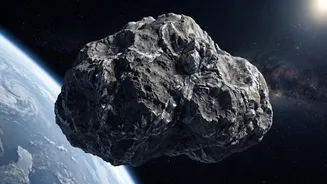
a groundbreaking computer model that serves as a digital dress rehearsal for deflecting a dangerous asteroid. Instead of treating asteroids as simple spheres, which was a common simplification, this new model embraces their true nature: lumpy, irregular, and unpredictable. This leap in realism is crucial, as early results from the simulations show that an asteroid’s unique shape can dramatically alter the outcome of any attempt to nudge it off course. By running thousands of virtual scenarios, researchers can test strategies and understand the physics of deflection in a way that is impossible to do in the vast emptiness of space, providing a playbook for protecting Earth long before a real threat is ever identified.
From Perfect Spheres to Lumpy Reality
For years, computational models simplified asteroids as perfect spheres to make the complex calculations manageable. 'The trouble is, spherical asteroids don't exist', noted Sandia physicist Nathan Moore, who led the research. The new approach shatters this limitation by combining two powerful simulation codes, named ALEGRA and SPARTA, into a single, cohesive model. ALEGRA is typically used to model high-energy events, while SPARTA simulates weaker forces. Together, they can accurately map how X-rays from a nearby nuclear detonation would vaporize the surface of a realistically shaped asteroid. This escaping gas and debris acts like a rocket engine, creating a gentle but firm push. The simulation generates a detailed heat map of the asteroid's surface, calculating the resulting change in its trajectory and spin. Perhaps most impressively, this new method is over 1,600 times faster than previous attempts, allowing scientists to analyse countless variables that were once too computationally expensive to explore.
Why Aiming Is Everything
The most startling discovery from Sandia’s simulations is just how much aiming matters. When dealing with a lumpy, potato-shaped asteroid, where you direct the force is not a minor detail—it can be the difference between success and failure. The models showed that targeting different sides of the same simulated asteroid could change the effectiveness of the deflection by nearly five times. The effect on the asteroid's rotation was even more pronounced, varying by a factor of 17 depending on the angle of the blast. 'We expected aim to matter', Moore said. 'What surprised us was how much'. This finding underscores a critical challenge: to successfully deflect an asteroid, mission planners would need detailed information about its shape and orientation. As Moore bluntly put it, 'Pick the right side and you win. Guess wrong and it could be a bad day'. The goal is to push the asteroid cleanly, not shatter it into multiple fragments that could still pose a threat to Earth.
Complementing Real-World Missions
This simulation-first approach doesn't replace real-world missions like NASA's successful DART (Double Asteroid Redirection Test), which physically crashed a spacecraft into an asteroid in 2022. Instead, it complements them. Computer models are essential for both planning and interpreting such missions. Before DART ever launched, extensive simulations were run to predict the possible outcomes of the impact. After the mission, the real-world data gathered from the collision is now being used to validate and refine those very computer models, making future simulations even more accurate. While a kinetic impactor like DART is one tool in the planetary defence toolkit, Sandia's research focuses on another option: a 'standoff' nuclear burst. This method uses the radiation from a detonation to push the asteroid, which could be a vital strategy for larger threats or when there is little warning time. By simulating these different scenarios, scientists can build a more versatile set of strategies to choose from.