






A Trial on India's Most Demanding Terrain
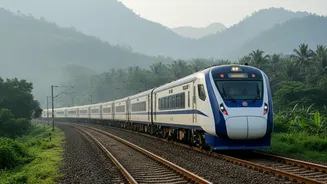
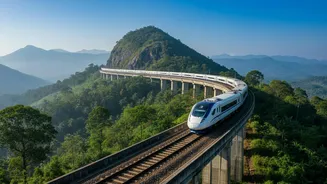
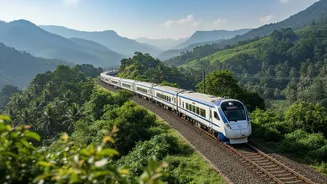
Indian Railways has commenced crucial field trials for the Vande Bharat Express on the highly challenging Sakleshpur-Subrahmanya Road ghat section in Karnataka. This 55-kilometre stretch, which cuts through the Western Ghats, is known for its steep gradients,
108 sharp curves, 57 tunnels, and 226 bridges. Historically, the terrain is so demanding that conventional trains require extra 'banker' locomotives to push them up and control their speed on the way down. These trials, which began in mid-August 2026, are designed to determine if the semi-high-speed Vande Bharat, equipped with its own advanced braking systems, can safely navigate this route without such assistance.
Spotlight on Automatic Emergency Braking
The primary focus of these tests is not on speed, but on safety. A specially prepared 20-coach Vande Bharat rake, built by the Integral Coach Factory in Chennai, has been equipped with an Automatic Emergency Braking (AEB) system for these trials. This system is designed to automatically apply the brakes if the train exceeds prescribed speed limits, a critical feature for the steep slopes of the ghat section. Personnel from the Research Designs and Standards Organisation (RDSO) are on board to assess braking behaviour, acceleration, stability, and overall performance under the unique stresses posed by the route. The success of the AEB system is paramount, as safety authorities had previously raised concerns about running a conventional Vande Bharat on this specific stretch without additional safeguards.
What About the Kavach System?
While the Karnataka trials are focused on the AEB for ghat navigation, they are part of a broader push by Indian Railways to enhance safety with indigenous technology. The most prominent of these is 'Kavach', an Automatic Train Protection (ATP) system designed to prevent collisions. Developed in India, Kavach automatically applies brakes if a loco pilot misses a signal or if two trains are detected on the same track, heading for a collision. It has the highest safety certification, SIL-4, and has been successfully tested at speeds up to 160 kmph. While not the primary system under scrutiny in the Sakleshpur-Subrahmanya tests, Vande Bharat trains are being progressively integrated with Kavach, representing a two-pronged approach to safety: AEB for terrain-specific risks and Kavach for network-wide collision avoidance.
The Bigger Picture for Connectivity
These trials are more than just a technical exercise; they are a gateway to enhanced connectivity between Bengaluru and the coastal city of Mangaluru. The introduction of a Vande Bharat service on this route has been anticipated for months, but the technical and safety clearance for the ghat section was a major hurdle. A successful outcome would not only reduce travel time significantly but also mark a major engineering and operational achievement for Indian Railways. It would prove that modern, self-propelled trainsets can be safely operated on legacy routes built for different types of trains, opening up possibilities for similar services across other challenging terrains in the country.