

The Cosmic Crash We Thought We Knew
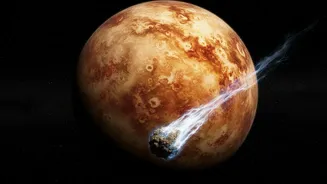
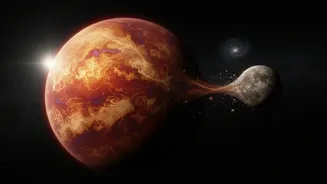
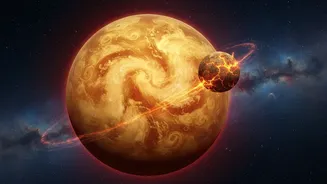
For decades, the giant-impact hypothesis has been the leading explanation for our Moon's existence. The theory goes that about 4.5 billion years ago, a Mars-sized protoplanet, nicknamed Theia, slammed into the still-forming Earth at a glancing angle.
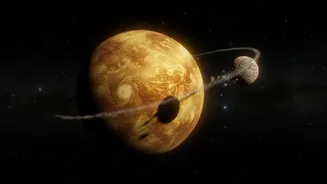
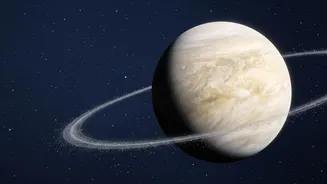
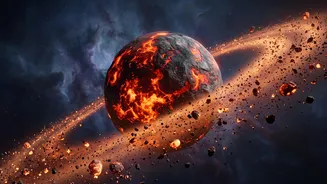
This cataclysmic event would have ejected a massive amount of molten rock and vapor into orbit. Over thousands or millions of years, this debris ring is thought to have slowly clumped together under gravity, eventually forming the Moon we see today. This story elegantly explains many things, including the Moon's size, its orbit, and why it's made of material that suggests it was once a magma ocean.
A Tale of Two Liquid Worlds
To study this ancient collision, scientists rely on powerful computer simulations. Given the immense energy involved—enough to melt and vaporize colossal amounts of rock—these models have historically made a simplifying assumption: they treated the proto-Earth and Theia as if they were two colliding spheres of liquid. This 'fluid dynamics' approach made the incredibly complex physics manageable. It assumed the primary forces at play were gravity and pressure, much like what happens when two water droplets merge. For a long time, it was believed that the sheer violence of the impact would make the actual material strength of the rock irrelevant.
The Key Qualification: Strength Matters
Here's the new wrinkle: recent, more sophisticated simulations are challenging that fluid-world assumption. A key qualification is that the colliding bodies might not have been completely molten. Depending on their temperature at the time of impact, large parts of the proto-Earth and Theia could have been solid or semi-solid. New models that incorporate this 'material strength' show that the collision would have behaved very differently. Instead of just splashing apart, a stronger, cooler body resists deformation. It shatters and breaks in a way that can fundamentally change how momentum is transferred and where the resulting debris ends up. The difference is like a water balloon hitting a wall versus a bowling ball hitting it.
Why This Changes the Story
This might seem like a small technical detail, but it has huge implications. One of the biggest puzzles of the giant-impact theory has been the 'isotope crisis'. Samples returned by the Apollo missions showed that the Moon's chemical composition is strikingly similar to Earth's mantle. If the Moon formed mostly from Theia's debris, as older fluid models suggested, it should look chemically different. The new strength-aware simulations offer a potential solution. Some of these new models show that a stronger impactor can break apart in such a way that it launches a large, intact chunk of material into orbit in a matter of hours, not millennia. This proto-Moon could be made of a better mix of Earth and Theia material, or even be a large piece of Earth's mantle that was sheared off, potentially explaining the chemical similarities.
A Faster, More Violent Beginning
The idea that the Moon could have formed almost instantly is a radical departure from the classic image of a slowly coalescing debris disk. High-resolution simulations now suggest that a recognizable Moon could emerge just hours after the initial collision. This doesn't disprove the giant-impact theory; it refines it, making it more robust. By accounting for the physical state of the colliding worlds, scientists are connecting the 'how' of the Moon's formation with the 'when'. A hotter, weaker Theia might produce a debris disk, while a cooler, stronger one could create an intact Moon right away. This ongoing research provides a clearer, albeit more complex, picture of one of the most important events in our planet's history.