


A New Look at a Cosmic Lion
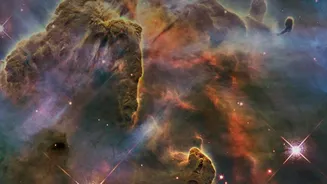
The James Webb Space Telescope (JWST) has turned its powerful infrared eyes toward NGC 2392, a celestial object famously known as the Lion Nebula. While the Hubble Space Telescope gave us a glimpse of this planetary nebula in 2000, Webb's technology provides
a much sharper, more detailed view. A planetary nebula has nothing to do with planets; it is the glowing shell of gas and dust cast off by a dying star similar to our own Sun. As the star at the center of the Lion Nebula exhausted its fuel, it shed its outer layers, creating the intricate structure we see today. The new image is a composite, combining data from Webb’s Near-Infrared Camera (NIRCam) and Mid-Infrared Instrument (MIRI) to reveal features that were previously hidden.
The Anatomy of a Stellar Goodbye
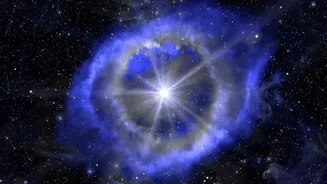
At the heart of the nebula lies the remnant of the star: a scorching hot core known as a white dwarf. This tiny but intensely powerful object is blasting radiation into the surrounding material, sculpting it into the shape of a lion's head. The 'face' of the lion is a bubble of expanding, ionized gas, which is actively destroying dust in its path. The fluffy 'mane' is an outer shell of dust, illuminated by the central white dwarf. One of the most fascinating details revealed by Webb are the comet-like clumps within this mane. These are dense pockets of dust that have so far survived the intense radiation, creating protective tails of material behind them.
A Story of Chaos and Creation
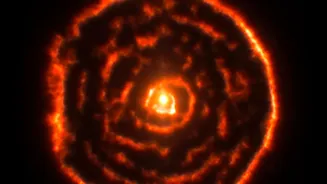
Unlike massive stars that go out with a bang in a supernova explosion, Sun-like stars have a more gradual, though still dramatic, end. Webb's portrait of the Lion Nebula is a snapshot of this process. The image reveals a complex structure of rings and shells within the gas bubble, a common but not fully understood feature of planetary nebulae. By studying the different temperatures and densities of the gas and dust, astronomers can piece together the history of the star's death throes. The clarity of Webb's instruments allows scientists to better understand how the intense radiation from the white dwarf interacts with the material the star previously ejected. This helps explain how these beautiful, complex structures are formed.
A Fleeting Cosmic Masterpiece
This stunning cosmic spectacle is temporary. Astronomers estimate that the entire structure of the Lion Nebula will continue to expand and drift away from the central star, dispersing completely in about 10,000 years. In astronomical terms, this is a very short period. The image from Webb freezes this fleeting moment in time, allowing us to study the life cycle of stars in incredible detail. The elements cooked up inside the star and then expelled into space—the very gas and dust forming the nebula—will eventually be recycled. They will mix with the interstellar medium and one day contribute to the formation of new stars and planetary systems. In this way, the death of one star lays the groundwork for the birth of future generations.