







The Shifting Timeline
The most significant change for the Mumbai-Ahmedabad High-Speed Rail (MAHSR) corridor has been its timeline. When the foundation stone was laid in 2017, the ambitious deadline for the entire project was 2022. However, challenges, primarily with land acquisition
in Maharashtra and pandemic-related disruptions, pushed this target significantly. The new strategy involves a phased rollout. According to recent statements from Railway Minister Ashwini Vaishnaw, the first section between Surat and Bilimora in Gujarat is now targeted for commissioning in 2027. This will be the first operational stretch, with services expected to begin in August 2027. While civil work on the Vapi-Surat section is expected to be completed by December 2026, the entire 508-km corridor connecting Mumbai to Ahmedabad is now projected to be fully completed around 2030.
The Escalating Costs
The project's budget has seen a substantial revision. The initial estimated cost was approximately ₹1.1 lakh crore, a figure largely based on a feasibility study and an agreement with the Japan International Cooperation Agency (JICA) for a soft loan. However, as of late August 2026, the estimated cost has nearly doubled to around ₹2.1 lakh crore. The railway ministry has attributed this sharp increase to several factors, including the prolonged land acquisition process, delays in finalizing train set procurement from Japan, and general inflation affecting construction material and labor costs. This revised cost required fresh Cabinet approval and is expected to change the project's funding structure, with a larger portion of the additional funds likely to come from government budgetary support rather than the initial financing plan.
From Setback to Progress
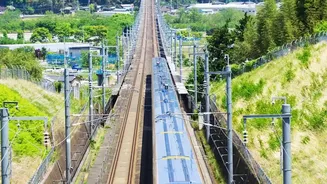
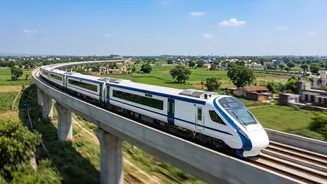
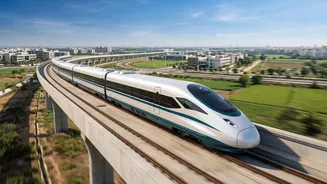
For years, the project's progress was hampered by significant hurdles, especially in acquiring the necessary land in Maharashtra. This was a key reason for the initial delays. However, by January 2026, land acquisition for the entire 508 km route was reportedly complete, paving the way for construction to accelerate. Now, work is advancing rapidly in both Gujarat and Maharashtra. As of mid-2026, major milestones have been achieved, with updates from the National High Speed Rail Corporation Limited (NHSRCL) showing hundreds of kilometers of pier work and viaduct construction completed. Bridge construction over several major rivers is finished, and even challenging tunnelling work in Maharashtra has seen breakthroughs. More than 400,000 noise barriers have also been installed along completed sections to minimize sound pollution in populated areas.
A Push for 'Make in India'
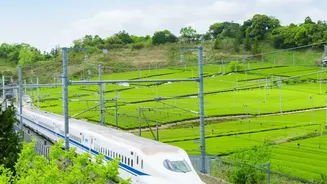
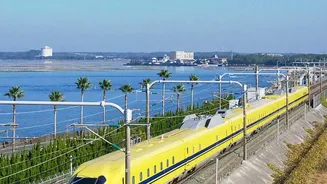
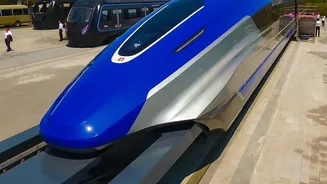
While the project began with a heavy reliance on Japanese Shinkansen technology and financing, there is now a significant push for domestic manufacturing under the 'Atmanirbhar Bharat' initiative. A major development is the plan to manufacture high-speed trains within India. BEML Limited has been tasked with developing India's first indigenous high-speed trainsets, capable of speeds up to 280 kmph. The first body frame of a prototype is ready and undergoing testing. These made-in-India trains are expected to begin trial runs on the corridor in mid-2027. This move is aimed at building domestic expertise, reducing long-term dependence on foreign technology, and creating a local ecosystem for future high-speed rail projects.