



A Cosmic Fossil Record
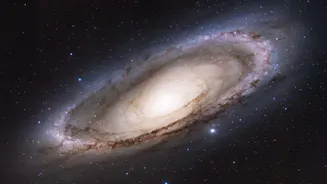
Using the Hubble Space Telescope, astronomers have created the most detailed map ever of Andromeda's recent history. By analyzing the light from approximately 200 million individual stars, scientists can essentially read the galaxy's fossil record. The
project combined data from two massive surveys—the Panchromatic Hubble Andromeda Treasury and its southern counterpart—to chart the galaxy's star-making activity over time. This was achieved by looking at the color of stars; young, hot, massive stars burn blue and have short lives, while older, cooler stars glow red and endure much longer. Regions rich in blue stars signify recent and vibrant star birth.
The Slowing Pace of Creation
The maps show a clear and steady decline in star formation over the last 500 million years. The data indicates that 500 million years ago, Andromeda was creating stars at a rate of about one solar mass per year. By 40 million years ago, that rate had been cut in half. Today, the stellar production has plummeted even further, to about one-fifth of a solar mass annually. This slowdown isn't happening uniformly. Much of the recent activity has been concentrated in a vast, sparkling ring of gas and dust about 32,000 light-years from the galaxy's center. It is the fading of this specific ring that is driving much of the galaxy-wide decline.
Winding Down, Not Running Out
Interestingly, Andromeda is not running out of the raw materials—the gas and dust—needed to create new stars. Instead, scientists believe the galaxy is in a natural winding-down period. This follows a massive burst of star formation that occurred about 2 billion years ago, likely triggered by a merger or interaction with a smaller galaxy. As lead author Tobin Wainer of the University of Washington put it, "It's just like after running a marathon, sometimes you've got to take a bit of a breather." This suggests that Andromeda's current quiet phase is a consequence of its more turbulent and productive past.
A Likely Suspect
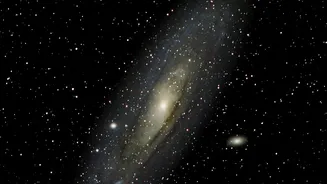
While the decline seems to be a natural process, astronomers are also investigating a potential accomplice: Andromeda's small satellite galaxy, Messier 32 (M32). Researchers noted a distinct drop in star formation in the area of Andromeda's disk near M32. They theorize that a past interaction, perhaps around 60 million years ago, could have disturbed the stellar nurseries in that region. While they can't definitively blame M32 for the slowdown, scientists have called it the "most likely suspect."
A Glimpse of Our Future?
Studying Andromeda, which is about 2.5 million light-years away, provides a unique laboratory for understanding how large spiral galaxies like our own Milky Way evolve. While our galaxy currently forms more stars than Andromeda—about 3 to 5 solar masses per year compared to Andromeda's one-fifth—the slow fade next door could offer clues to our own distant future. The processes governing galactic life cycles are universal. Understanding why a neighboring galaxy is dimming its stellar lights helps us piece together the long-term fate of the Milky Way, especially as the two galaxies are on a collision course set to merge in about 4.5 billion years.