







Cosmic Misfits: Neither Star nor Planet
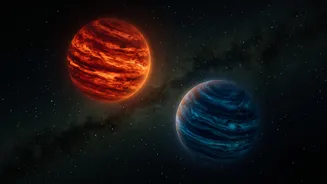
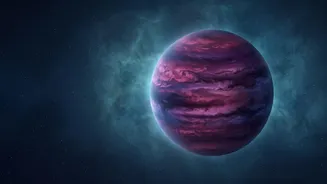
These mysterious in-between objects are known as brown dwarfs. Often called 'failed stars', they form from collapsing clouds of gas and dust, just like stars do. However, they never accumulate enough mass to kickstart the nuclear fusion of hydrogen in their
cores, the process that makes stars shine brightly. While they can't sustain fusion like a star, they are generally more massive than planets, typically ranging from about 13 to 80 times the mass of Jupiter. This puts them in a unique category, glowing dimly from their own internal heat but destined to cool and fade over time. They are so faint and cool that they emit most of their light in the infrared, making them nearly invisible to standard telescopes.
NASA's New Eye on the Cosmos
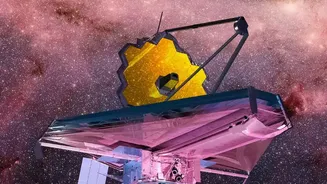
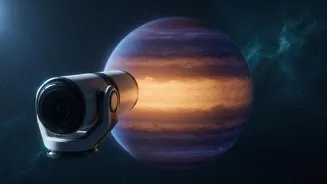
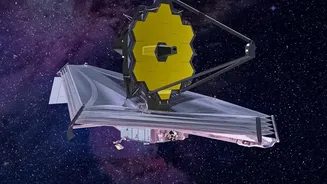
Enter SPHEREx, which stands for Spectro-Photometer for the History of the Universe, Epoch of Reionization, and Ices Explorer. Launched in March 2025, this space observatory is a powerful new tool in NASA's arsenal. Unlike telescopes like James Webb that perform deep, focused studies of small patches of sky, SPHEREx is an all-sky surveyor. Every six months, it maps the entire sky, creating a comprehensive census of the cosmos. Its primary mission is to tackle some of the biggest questions in astrophysics, including how the universe began and how galaxies evolved. But its unique capabilities are also making it the perfect instrument for hunting and characterizing thousands of these elusive brown dwarfs.
Seeing the Universe in a New Light
The key to SPHEREx's power is its ability to see the sky in near-infrared light, specifically in 102 different 'colors' or spectral bands. This is a crucial advantage because Earth's atmosphere absorbs many of these infrared wavelengths, making them impossible to observe from the ground. By operating from space, SPHEREx can capture the faint, reddish glow of brown dwarfs. More importantly, it performs spectroscopy on everything it sees. This means it breaks down the light from each object into its constituent colors, creating a unique 'fingerprint' or spectrum. This spectrum reveals a wealth of information about an object's chemical composition, temperature, and other physical properties.
A Cosmic Census of Brown Dwarfs
Before SPHEREx, only a few dozen brown dwarfs had been studied in detail. Now, scientists are using the telescope's all-sky maps to analyze thousands of them. Recent findings have revealed that these dimly glowing worlds have chemically rich atmospheres, with detections of water, methane, carbon dioxide, and carbon monoxide. By analyzing the light from these objects across its wide infrared range, scientists can get a better handle on their temperature and chemistry. This is crucial because even brown dwarfs at the same temperature can have surprisingly distinct spectra, suggesting that no two are exactly alike. This diversity challenges existing atmospheric models and helps scientists refine their understanding of how these objects form and evolve.
Beyond Failed Stars to Planetary Clues
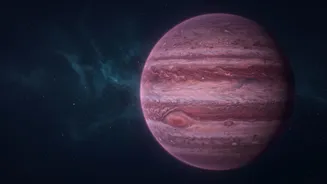
Studying brown dwarfs isn't just about understanding failed stars; it also provides a crucial link to understanding giant planets. Since many brown dwarfs float freely in space without the blinding light of a host star, they serve as pristine laboratories for studying atmospheric physics similar to what might be found on gas giants in other solar systems. The insights gained from SPHEREx's observations help scientists test and improve the models they use to interpret the atmospheres of exoplanets. Furthermore, SPHEREx's survey for water and organic molecules in stellar nurseries—the birthplaces of stars and planets—complements the study of brown dwarfs by painting a fuller picture of the ingredients available for building planetary systems across the galaxy.