





An Invisible Population
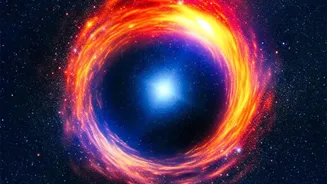
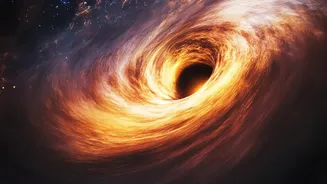
Black holes are the ghosts of the cosmos. Formed from the collapsed cores of massive stars, their gravitational pull is so immense that not even light can escape, making them impossible to see directly. So, how do you find something that's invisible?
Until now, astronomers have mostly found black holes when they're 'feeding'. If a black hole is close to a star, it can siphon off gas and dust. As this material spirals into the black hole, it heats up and emits powerful X-rays that our telescopes can detect. But most black holes aren't actively feeding. They are quiet, solitary wanderers or part of a pair where they don't interact with their companion star. These 'quiet' black holes are thought to make up the vast majority of the galactic population, but they remain almost completely hidden from us.
The Cosmic Magnifying Glass
The Black Hole Hunters project uses a clever trick of physics called gravitational microlensing. Albert Einstein's theory of general relativity tells us that massive objects warp the fabric of spacetime. This warping can bend the path of light, much like a glass lens does. When a massive, dark object like a black hole passes almost directly in front of a more distant star from our point of view, its gravity acts as a natural magnifying glass. For a brief period, the light from the background star is focused and amplified, causing the star to appear temporarily brighter. This sudden, characteristic brightening is the 'light pattern' the project is searching for. It's a fleeting signpost that an invisible object has just drifted by. The duration and shape of this brightening can even help scientists estimate the mass of the lensing object, allowing them to distinguish a black hole from a less massive object like a neutron star or a rogue planet.
Calling All Citizen Scientists
The search for these microlensing events involves sifting through enormous amounts of data. Telescopes like NASA's Transiting Exoplanet Survey Satellite (TESS) and the earlier SuperWASP survey have monitored the brightness of hundreds of millions of stars over many years. Looking for these specific brightening patterns in such a vast dataset is a monumental task. While computer algorithms can help, the human eye is often better at spotting subtle or unusual patterns that automated systems might miss. This is where the Black Hole Hunters project, hosted on the Zooniverse platform, comes in. It invites volunteers from the public—no astronomy degree required—to look at graphs of star brightness, called light curves, and flag any that show the distinctive peak of a microlensing event. By doing so, citizen scientists help astronomers narrow down the list of candidates for further study with more powerful telescopes.
What the Hunt Could Reveal
Since its launch, the Black Hole Hunters project has seen thousands of volunteers make millions of classifications. Every potential candidate they identify could be the key to a major discovery. Finding these hidden black holes is about more than just boosting the numbers. Each new discovery helps astronomers build a more complete census of our galaxy's contents. It will allow them to test theories about how massive stars live and die, and how many black holes are formed in the process. It could also reveal more about binary systems where a star co-orbits with a black hole, which are thought to be common but are rarely found. By mapping out the population of these dark objects, we gain a deeper understanding of the evolution of our own cosmic neighbourhood, the Milky Way.