



The World's Most Critical Chokepoint
At its narrowest, the Strait of Hormuz is just 54 kilometres wide, separating Iran from Oman and connecting the Persian Gulf to the open ocean. Yet, through this slender passage travels a colossal amount of the world's energy. Roughly one-fifth of all
globally traded oil and a significant portion of liquefied natural gas (LNG) make their way through these waters every day. For energy-hungry nations like India, China, and Japan, the strait is a lifeline. Countries like Saudi Arabia, the UAE, Iraq, and Kuwait depend on it to get their primary export to market. This concentration of traffic in a geopolitically sensitive region makes the strait a constant focus of international attention. Any disruption, whether from political tensions, military conflict, or accidents, can send shockwaves through the global economy.
A Highway on the High Seas
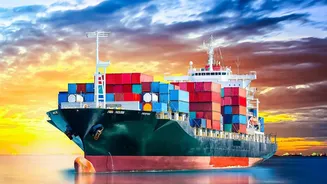
To manage the immense volume of traffic and prevent chaos, the maritime world relies on a system known as a Traffic Separation Scheme (TSS). Think of it as a highway for supertankers. The TSS in the Strait of Hormuz, recognised by the UN's International Maritime Organization (IMO), establishes two distinct lanes, each about 3.7 kilometres wide. One lane is exclusively for inbound traffic entering the Persian Gulf, and the other is for outbound traffic heading to the Indian Ocean and beyond. Between these two lanes lies a buffer zone, also about 3.7 kilometres wide, which ships are supposed to avoid. This simple division creates order out of potential chaos, dramatically reducing the risk of head-on collisions between massive vessels that can take several kilometres to stop or turn.
The Rules of the Road
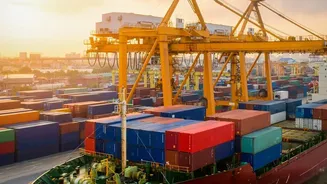
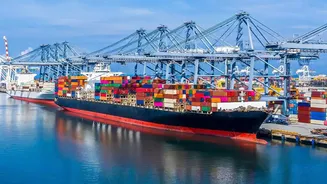
The TSS is more than just lines on a map; it is governed by Rule 10 of the International Regulations for Preventing Collisions at Sea (COLREGS). These rules are binding for all vessels. Ships must proceed in the designated direction within their lane and keep clear of the separation zone. Crossing a lane is strongly discouraged, but if it's unavoidable—for instance, to reach a port—it must be done at an angle as close to 90 degrees as possible to minimise the time spent in the opposing traffic flow. This entire system is often monitored by a Vessel Traffic Service (VTS), which acts like air traffic control for the sea, ensuring ships adhere to the rules and maintain safe distances. This rigid set of procedures is what allows thousands of vessels, from colossal oil tankers to container ships, to navigate the constrained waterway safely each year.
Why Hormuz Matters to India
For India, the smooth functioning of the Hormuz shipping lanes is not a distant concern—it's a core component of national energy security. A significant percentage of India’s crude oil imports, historically around 40-60%, has transited the strait, supplied by key partners in the Gulf region. Furthermore, over half of the nation's LNG imports, crucial for power generation and fertilizer production, also pass through this chokepoint. Any disruption directly threatens to increase fuel prices and impact industries across the country. In response to regional tensions, India has worked to diversify its energy sources and has even rerouted some imports to Omani ports outside the strait, but the waterway's importance remains profound. The stability provided by the two-lane system is, therefore, directly linked to the stability of India’s economy.