

A Gaze into the Lion's Eye
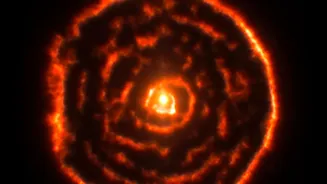
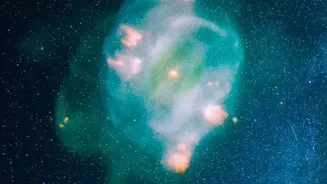
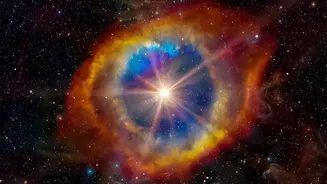
Located approximately 6,500 light-years away in the constellation Gemini, the Lion Nebula is the glowing ghost of a star that was once much like our Sun. Officially known as NGC 2392, its striking appearance has earned it its nickname; the swirling clouds
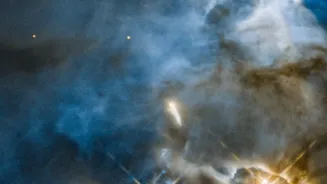
of gas and dust resemble a lion's face, complete with a magnificent mane. For years, telescopes like the Hubble have captured its beauty, showing a complex structure with an inner bubble of gas and a spikier, filament-like outer ring. But these new images, captured by Webb's powerful infrared instruments, cut through the cosmic haze to show these features with unprecedented sharpness, turning a familiar celestial sight into a fresh scientific puzzle.
The Ghost of a Sun-Like Star
Despite its name, a planetary nebula has nothing to do with planets. The term is a historical holdover from the 18th century, when these round, fuzzy objects looked like gas giant planets through early telescopes. In reality, they are the final, fleeting stage in the life of a low-mass star. When a star like our Sun runs out of nuclear fuel, its core collapses while its outer layers are puffed away into space. The hot, dense core, now a white dwarf, unleashes intense radiation that causes the expelled gas to glow brightly. The resulting spectacle is a planetary nebula—a beautiful, expanding shell of gas and dust that will eventually disperse over about 10,000 years, a mere blink of an eye in cosmic time.
Webb's Infrared Advantage
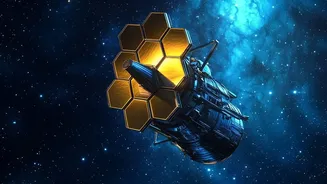
What makes Webb's new portrait so revolutionary is its ability to see the universe in infrared light. While Hubble sees primarily in visible and ultraviolet light, Webb is designed to detect the longer, cooler wavelengths of infrared. This allows it to peer through clouds of dust that would otherwise obscure our view, much like how infrared goggles can see through smoke. In the case of the Lion Nebula, Webb’s Near-Infrared Camera (NIRCam) and Mid-Infrared Instrument (MIRI) work together to reveal the hidden architecture of the nebula. Webb can distinguish between hot, ionized gas being blasted by the central star and the cooler, dense clumps of dust and molecular hydrogen that manage to survive in its outer mane. This provides a much clearer map of the materials and forces at play.
Decoding an Intricate Structure
The new image gives scientists a sharper focus on the very structures that make the Lion Nebula so complex. The 'face' of the lion is a bubble of extremely hot gas expanding outwards, destroying dust in its path. The 'mane' is composed of the cooler, outer shell of material ejected by the star earlier in its death throes. Webb's view details how the intense radiation from the central star illuminates this mane, while also revealing compact clumps of dust with comet-like tails. These are dense pockets that have so far survived the onslaught, shielding the material behind them. Studying the shape, temperature, and composition of these distinct zones helps astronomers understand the chaotic physics of how stellar winds and radiation sculpt the gas and dust shed by a dying star.
A Preview of Our Solar System's Destiny
Observing the Lion Nebula isn't just an exercise in cosmic sightseeing; it's a glimpse into the distant future of our own solar system. In about five billion years, our Sun will exhaust its fuel and begin its own transformation into a white dwarf, casting off its outer layers to form its own planetary nebula. The planets, including Earth, will be engulfed in this process. By studying objects like NGC 2392 in such fine detail, astronomers are essentially conducting cosmic forensics, piecing together the story of stellar evolution. Each new image from Webb provides crucial clues about the final chapters of a star's life, refining our understanding of how stars enrich the universe with new elements that will one day form new stars and planets.