

Mehrangarh Fort, Jodhpur
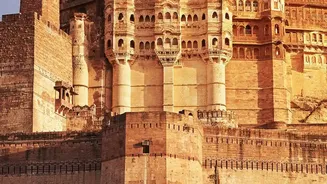
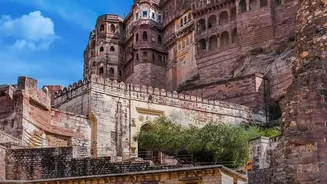
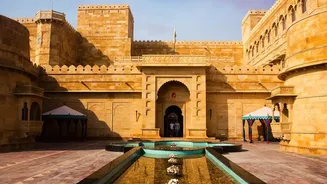
Perched on a 400-foot hill, Mehrangarh Fort dominates the Jodhpur skyline, a formidable symbol of Rajput power. Founded in 1459 by Rao Jodha, its massive walls, which rise up to 36 meters, seem to grow organically from the rock itself. Inside, a series
of palaces showcase the delicate artistry of Rajasthani craftsmen. The Moti Mahal (Pearl Palace) and Phool Mahal (Flower Palace) feature intricate carvings, expansive courtyards, and delicate latticework, reflecting the grandeur of the Rathore clan. The fort is a pure expression of Marwari architecture, built for defence and designed for royalty.
Red Fort, Delhi
The pinnacle of Mughal architectural brilliance, the Red Fort, or Lal Qila, was commissioned by Emperor Shah Jahan in 1639 when he moved his capital from Agra. Designed by Ustad Ahmad Lahori, the architect behind the Taj Mahal, the fort is a masterpiece of symmetry and ornamentation. Its towering red sandstone walls enclose a complex of palaces that fuse Persian, Timurid, and Hindu architectural traditions. Structures like the Diwan-i-Aam (Hall of Public Audience) and the private pavilions connected by the Nahr-i-Behisht (Stream of Paradise) exemplify the refined aesthetic that defined Shah Jahan's reign, creating a vision of paradise on Earth.
Golconda Fort, Hyderabad
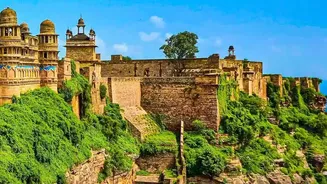
Originally a mud fort under the Kakatiya dynasty, Golconda was transformed into a granite behemoth by the Qutb Shahi kings in the 16th and 17th centuries. This fort represents the distinct Hindu-Islamic architectural style of the Deccan sultanates. Famed for its ingenious acoustics, a clap at the Fateh Darwaza (Victory Gate) can be heard at the highest point, almost a kilometer away, a feature designed as an early warning system. Once a center of the world's diamond trade, its robust fortifications, including 87 bastions and eight gates, protected immense wealth.
Gingee Fort, Tamil Nadu
Often called the "Troy of the East" for its impregnability, Gingee Fort is a sprawling complex built across three hillocks in Tamil Nadu. Its origins date back to the 13th century, but it was the Vijayanagara Empire that elevated it to a major stronghold. The architecture is a prime example of South Indian military design, characterized by massive granite walls that connect the three citadels. Within its fortified walls lie temples, granaries, and the iconic Kalyana Mahal, a seven-story tower that showcases the elegant style of the Nayaka rulers who succeeded the Vijayanagara kings.
Daulatabad Fort, Maharashtra
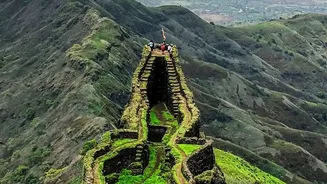
Originally named Devagiri ('Hill of the Gods'), this fortress near Aurangabad is a marvel of medieval military engineering. Built in the 12th century by the Yadava dynasty, it sits on a 200-meter-high conical hill. What makes it unique is its defense system. The fort has only one entrance and is protected by a series of deceptive, winding passages, including a pitch-black labyrinth known as the 'Andheri' designed to trap and confuse invaders. Carved from a single rock, with sheer cliffs and a deep moat, it was considered one of the most secure forts in the Deccan.
Amber Fort, Jaipur
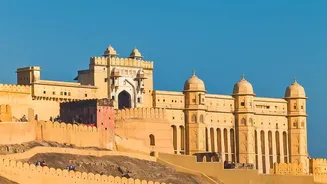
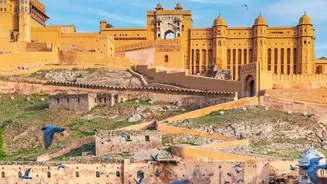
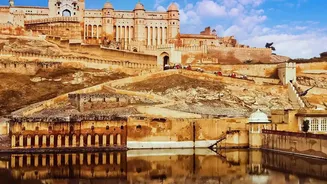
A stunning blend of Rajput and Mughal architecture, Amber Fort was the seat of the Kachwaha rulers before they moved their capital to Jaipur. First built by Raja Man Singh I in 1592, the fort is made of red sandstone and white marble. It displays a beautiful synthesis of styles; the robust defensive exterior protects ornate inner palaces. The fort is famed for the Sheesh Mahal (Mirror Palace), where the walls and ceiling are encrusted with thousands of tiny mirrors that can illuminate the entire hall with a single flame, showcasing a fusion of imperial Mughal aesthetics with local Rajput artistry.
Kangra Fort, Himachal Pradesh
Believed to be the oldest recorded fort in India, Kangra Fort's history stretches back to the 4th century BCE. Built by the Katoch dynasty, it stands on a steep rock overlooking the confluence of the Banganga and Manjhi rivers, with the Dhauladhar mountain range as a dramatic backdrop. The fort’s architecture is a testament to Himalayan ingenuity, with massive stone walls, seven gates, and several ancient temples inside its complex. It has been ruled by numerous powers, from Hindu kings to the Mughals and the British, with each leaving their mark on this ancient Himalayan stronghold.