


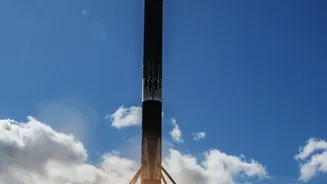
What is the Starship Catch?
For years, SpaceX has been landing its Falcon 9 boosters, but the Starship program has a far more ambitious goal: full and rapid reusability. This means recovering not just the first-stage Super Heavy booster, but also the Starship upper stage — the part
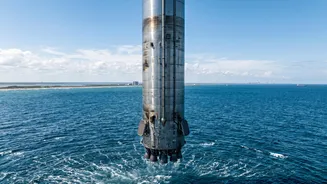
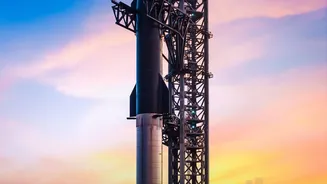
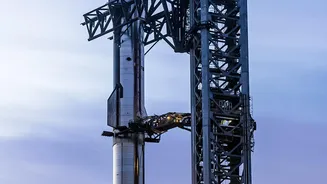
that actually reaches orbit. Instead of landing on legs, the plan is to catch both components in mid-air using the giant mechanical arms on the launch tower, nicknamed 'Mechazilla'. On its 15th test flight, SpaceX successfully caught the Starship upper stage, Ship 42, after it spent over 22 hours in orbit. While the plan was to catch the Super Heavy booster as well, it was diverted to a splashdown in the Gulf of Mexico due to a low fuel alarm.
The Challenge of Catching a Spacecraft
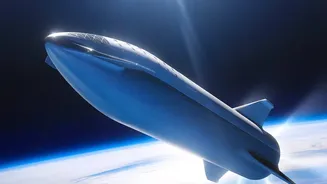
Catching the Starship upper stage is significantly more difficult than catching the booster. The booster merely travels to the edge of space before returning. The Starship, on the other hand, must re-enter the atmosphere from orbital velocity, enduring temperatures of thousands of degrees. It then performs a horizontal 'belly-flop' maneuver using its four flaps to control its descent before flipping to a vertical orientation for the final approach. The vehicle must then autonomously navigate with pinpoint precision to position itself perfectly between Mechazilla's 'chopstick' arms, which close around dedicated catch points on the ship's body. The entire sequence, from re-entry to the gentle capture, is a monumental engineering feat that tests the limits of materials science and automated guidance systems.
Why the Catch is a Game-Changer
The primary driver for this complex recovery method is economics and speed. Eliminating landing legs saves weight, allowing the rocket to carry more payload. More importantly, catching the vehicle directly at the launch pad streamlines the process for the next flight. Instead of a lengthy recovery from the ocean, the ship and booster can theoretically be inspected, refueled, and restacked on the launch mount in a matter of days, not weeks or months. This 'aircraft-like' turnaround is what could drastically reduce the cost of launching cargo and people into orbit, from millions of dollars per mission to a figure closer to the cost of fuel. It's this efficiency that underpins SpaceX's plans for massive satellite constellations like Starlink and, eventually, missions to the Moon and Mars.
From a Single Catch to True Reusability
While the successful catch of Ship 42 is a historic achievement, it is just one step on a long road. The next phase for SpaceX is to prove the process is repeatable and reliable. Engineers will now meticulously inspect the recovered spacecraft to assess the condition of its heat shield and other systems after the grueling re-entry. The true test of reusability will be successfully re-flying a caught vehicle. Questions remain about how much refurbishment will be needed between flights and how many missions a single Starship can endure. The failure to catch the Super Heavy booster on this same mission also highlights that mastering the 'double catch' for every flight is a significant remaining challenge.