






The Beating Heart of a Distant World
Pluto’s most iconic feature is a vast, bright, heart-shaped region named Tombaugh Regio. The western lobe of this heart is a massive basin called Sputnik Planitia, a sprawling glacier of frozen nitrogen larger than Texas and Oklahoma combined. When the
New Horizons spacecraft flew past Pluto in 2015, it revealed that this plain was remarkably smooth and almost entirely free of impact craters. This was a major clue: it meant the surface was young, geologically speaking, and was constantly being renewed. Scientists determined this was due to a slow-motion churning, or convection, of the solid nitrogen ice. Warmer ice from deep below rises, cools, and then sinks again, like blobs in a giant, cosmic lava lamp, smoothing the surface over millions of years.
A 'Bleeding' Glacier of Nitrogen
Now, a new study adds another layer of activity to this already fascinating world. By re-examining high-resolution images from New Horizons, planetary scientists have identified strange dark streaks and patches along the boundaries of the icy convection cells in northern Sputnik Planitia. According to research published in the Planetary Science Journal, these markings strongly resemble features on Earth’s glaciers where liquid water has welled up from beneath and darkened the surface. Since Pluto’s thin atmosphere and extreme cold make nitrogen rain impossible, the team concluded the most likely explanation is that liquid nitrogen is seeping up from below the ice sheet. This is the first evidence suggesting recently flowing liquid on Pluto's surface.
How to Melt Ice on a Frozen Planet
The idea of liquid on a world where surface temperatures hover around minus 230 degrees Celsius seems counterintuitive. However, the theory rests on basic physics. Sputnik Planitia's nitrogen ice sheet is believed to be several kilometers thick. Computer models run by the research team showed that the immense pressure at the base of this thick glacier, combined with modest heat flowing from Pluto’s rocky core, could be sufficient to melt the nitrogen ice into a liquid state. This liquid nitrogen, being slightly less dense than the solid ice above it, would then be squeezed upwards through cracks and conduits. Once it reaches the surface, it would briefly flow or pool, 'wetting' the solid nitrogen and darkening it before freezing again, creating the patterns seen by New Horizons.
Redefining a 'Living' World
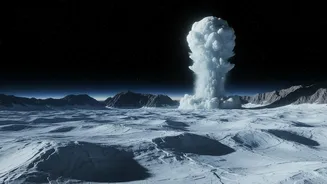
This discovery transforms our understanding of what it means for a world to be geologically active. For a planet so far from the sun, this 'cryovolcanism'—a chilly version of volcanism involving ices instead of molten rock—shows that internal heat and pressure can still drive dynamic processes. As Alan Stern, the New Horizons principal investigator, noted, “Pluto never stops surprising us.” These findings suggest that Pluto has a kind of active plumbing system under its ice, a process that might not be unique to the dwarf planet. Similar mechanisms could be at play on other icy bodies in the outer solar system, like Neptune’s moon Triton, which is also known to have geysers erupting nitrogen. It forces scientists to consider that even the coldest, most distant worlds can have complex and evolving landscapes.
The Gift That Keeps on Giving
What’s truly remarkable is that these groundbreaking conclusions are being drawn from data gathered during a brief flyby that happened over a decade ago, in 2015. The New Horizons mission provided a treasure trove of images and measurements that scientists are still unpacking, using new models and comparisons to Earth-based systems to reveal secrets hidden in plain sight. The comparison of Sputnik Planitia's features to satellite imagery of Greenland's ice sheets was a key part of strengthening the hypothesis. Each new analysis reinforces the idea that Pluto is not a simple, dead world but a complex and active one, with a story that continues to unfold years after humanity’s first and only visit.