

The Sun’s Invisible Threat
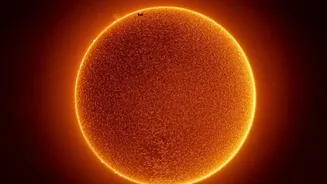
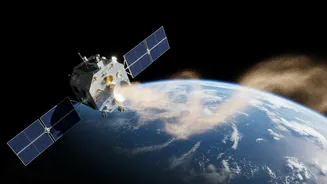
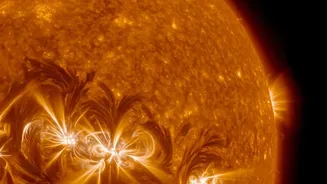
The Sun, our life-giving star, isn't always benign. It continuously emits a stream of charged particles known as the solar wind. This isn't a gentle breeze; it's a plasma current traveling at speeds of up to two million miles per hour. At times, the Sun unleashes
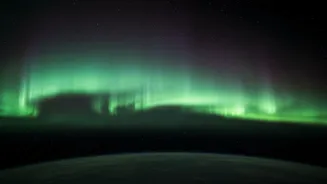
even more powerful bursts, called Coronal Mass Ejections (CMEs), which hurl billions of tons of magnetised plasma into space. While Earth's magnetic field, or magnetosphere, protects us from the worst of this onslaught, a particularly strong gust or a direct hit from a CME can cause significant disruption, creating what is known as space weather.
Our Technological Vulnerability
In the 21st century, our dependence on technology makes us more vulnerable than ever to severe space weather. An intense solar storm can induce powerful electrical currents in power grids on the ground, potentially causing widespread blackouts like the one that struck Québec, Canada, in 1989. Beyond the power grid, these storms can damage the sensitive electronics in satellites, disrupting the GPS, communication, and broadcasting services that are deeply integrated into India’s economy and daily life. It also poses radiation risks to astronauts in orbit and even passengers and crew on long-haul polar flight routes.
Introducing IMAP: The Game Changer
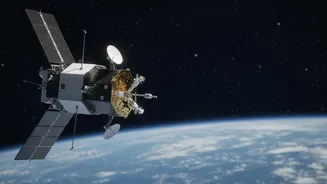
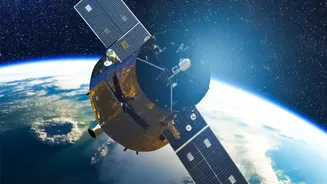
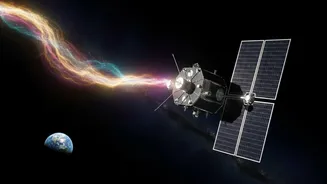
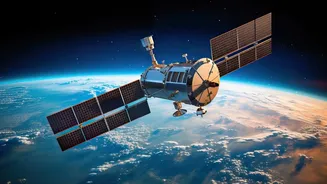
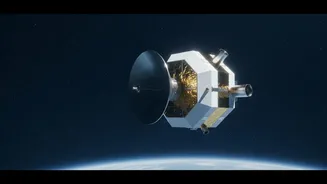
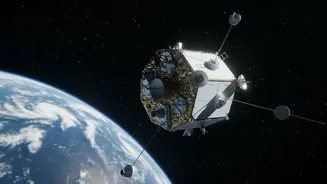
To counter this threat, we need a reliable early-warning system. This is the primary role of NASA's Interstellar Mapping and Acceleration Probe, or IMAP. Launched in September 2025, IMAP journeyed to a unique spot in space: the first Lagrange point (L1), located about 1.5 million kilometers from Earth in the direction of the Sun. At this gravitationally stable point, IMAP has an uninterrupted view of the Sun and the approaching solar wind. Think of it as a dedicated space weather buoy stationed far upstream, waiting to detect any changes in the current.
How Near-Real-Time Data Works
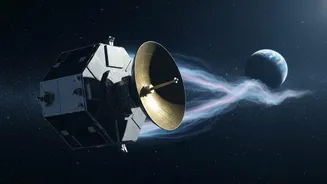
IMAP's strategic position at L1 means it encounters the solar wind roughly 30 to 60 minutes before those same particles reach Earth. Its suite of ten advanced instruments, including sensors for solar wind particles and magnetic fields, continuously measures the speed, density, and magnetic orientation of the incoming solar wind. Crucially, a portion of this data is sent back to Earth in near-real-time through a system called the IMAP Active Link for Real-Time (I-ALiRT). This constant, low-latency stream of information gives space weather forecasters at agencies like NOAA the critical lead time they need to issue accurate warnings.
A New Era of Preparedness
That 30-to-60-minute warning is a paradigm shift in space weather preparedness. It’s enough time for power grid operators to take protective measures, such as adjusting grid loads to prevent overload and cascading failures. Satellite operators can command their spacecraft into a safe mode to protect sensitive electronics, and airlines can reroute flights away from polar regions where radiation exposure would be highest. For future crewed missions to the Moon and Mars, such warnings will be absolutely essential for ensuring astronaut safety. The data, which became publicly available in early 2026, is already enhancing forecast models and improving the timeliness of alerts.