






Cosmic Misfits: What Are Brown Dwarfs?
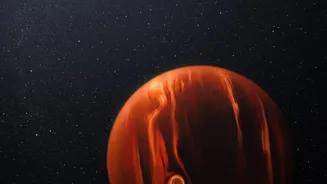
Imagine an object that forms from a collapsing cloud of gas and dust, just like a star, but never quite makes it. That's a brown dwarf. These celestial bodies are more massive than Jupiter but fall short of the mass needed to ignite and sustain the nuclear
fusion that powers stars. Because they don't shine brightly like stars, they are often called 'failed stars'. Instead of producing their own light through fusion, they glow faintly from the residual heat of their formation, slowly cooling and fading over billions of years. This puts them in a unique category, a fascinating middle ground between giant planets and the smallest stars, with some researchers affectionately describing them as 'goth' because they are fated to drift alone in the eternal darkness of space.
NASA's SPHEREx Takes a Closer Look
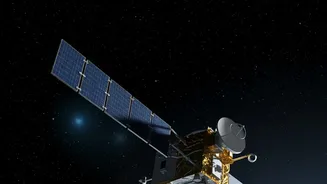
To study these dim objects, scientists need powerful tools. Enter NASA's SPHEREx (Spectro-Photometer for the History of the Universe, Epoch of Reionization, and Ices Explorer) space telescope. Launched in 2025, SPHEREx is on a mission to create a comprehensive 3D map of the sky. It does this by observing in 102 different colors of light, stretching from deep red into the infrared spectrum, which is invisible to the human eye. This capability is crucial for studying brown dwarfs, which emit most of their faint light at these infrared wavelengths. Different molecules in an atmosphere absorb specific colors of light, creating a unique 'fingerprint' or spectrum. By analyzing these spectra, scientists can identify the chemical ingredients present.
A Surprising Chemical Menagerie
In a recent study published in The Astrophysical Journal, researchers used SPHEREx to analyze 37 nearby brown dwarfs. The findings confirmed that their atmospheres are chemically complex, containing a mix of water, carbon dioxide, carbon monoxide, and methane. More importantly, the study revealed a remarkable diversity among them. The analysis showed that no two brown dwarfs are exactly alike; even those with similar temperatures can have distinctly different chemical makeups. As lead author Zafar Rustamkulov noted, current atmospheric models struggle to explain this variety, especially for brown dwarfs caught in a transitional phase where their cloudy skies begin to clear and give way to methane-rich atmospheres. This suggests that their formation and evolution are more complex than previously thought.
Why This Cosmic Weather Report Matters
This discovery is more than just an interesting tidbit about obscure space objects. Brown dwarfs serve as valuable analogues for understanding the atmospheres of giant exoplanets. Because brown dwarfs often float freely in space, they are easier to study than exoplanets, which are usually lost in the blinding glare of their host stars. By studying the 'weather' and chemistry of brown dwarfs—including their exotic clouds made of hot sand grains and other elements—scientists can test and refine their models of atmospheric physics. The chemical variety seen by SPHEREx suggests that brown dwarfs might form under a wide range of conditions, providing crucial insights into the broader processes of how both stars and giant planets are born. According to J. Davy Kirkpatrick, a co-author of the study, this work has effectively turned astronomers into 'accidental meteorologists', highlighting the challenge of predicting conditions on these strange worlds.