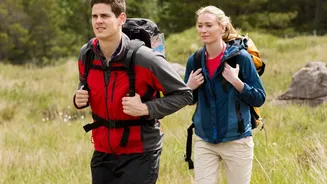








Jogging and hiking are two of the most popular ways to get fit and enjoy the outdoors. But while they may seem similar, they offer vastly different experiences. One is a masterclass in control, the other a lesson in adaptation. So what sets them apart?
The Predictability of the Jog
For many, the appeal of jogging lies in its consistency. Whether on a treadmill, a track, or a familiar neighbourhood loop, you can largely control the key variables of your workout. You can set a specific pace, maintain a target heart rate, and run for a predetermined distance or time. This makes jogging an exceptionally predictable and repeatable form of exercise. This standardisation is a powerful tool for anyone training for a specific goal, like a 5K or marathon, or for those who simply want to measure their progress with precision. The environment is often a constant, allowing the focus to remain purely on the physical output. You can run the same three-mile course today and a month from now and have a clear, direct comparison of your performance.
Measuring the Effort
The ability to standardise jogging is supported by a wealth of measurable data. Metrics like Metabolic Equivalents (METs) provide a scientific way to compare the energy expenditure of different activities. For instance, jogging at a steady pace has a relatively consistent MET value, making it easy to calculate calorie burn and effort level. Runners can meticulously plan workouts, incorporating specific intervals, tempo runs, and recovery jogs to achieve desired physiological adaptations. This level of control allows for a structured approach to fitness, where improvements can be systematically pursued and tracked over time.
Hiking and the Call of the Wild
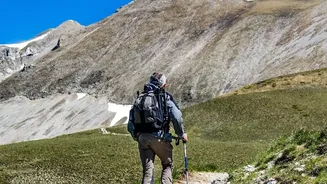
Hiking, by its very nature, resists such easy standardisation. While distance is a factor, it's a poor indicator of a hike's true difficulty. A three-mile hike can be a gentle stroll or a gruelling, vertical scramble. The primary determinant of a hike's challenge is the terrain itself. Factors like elevation gain, trail surface (from smooth dirt to treacherous scree fields), weather conditions, and even altitude transform each outing into a unique event. Unlike a jogger on a paved path, a hiker is in constant dialogue with their environment, forced to react and adapt to whatever the trail presents.
Why Terrain Is King
The term 'terrain' in hiking covers a vast range of variables. A steep incline will test your cardiovascular system and glutes far more than a flat trail. A path littered with rocks and roots requires constant focus and engages smaller stabilising muscles in your ankles and core to prevent a fall. A muddy trail can turn a moderate walk into a high-effort slog. These factors are why hiking difficulty is often described on a scale, considering everything from elevation to potential weather exposure. Even experienced trail runners know there are points where the grade becomes so steep or the footing so technical that hiking becomes the more efficient and sustainable option.
A Different Kind of Workout
Physiologically, the two activities recruit muscles in different ways. Running is a high-impact, cyclical motion that primarily works the major muscles of the legs like the glutes, quads, hamstrings, and calves in a repetitive pattern. Hiking works these same major muscles but adds a significant layer of complexity. The uneven surfaces demand constant micro-adjustments, activating stabilising muscles throughout the hips, legs, and core that might get less work during a standard run. Carrying a pack further increases the load and muscular demand, making hiking a formidable full-body workout.
Control vs. Adaptation
Ultimately, the choice between jogging and hiking comes down to a preference for control versus a desire for adaptation. Jogging offers a controlled environment perfect for targeted training and easily measurable progress. It allows for a meditative rhythm where you can switch off and focus on the repetition of movement. Hiking is about embracing variability. It challenges you to read the landscape, make constant adjustments, and use your body in a more holistic and reactive way. It’s less about hitting a specific pace and more about navigating the journey itself. One standardises the challenge; the other makes the challenge the adventure.