








Meet SOLVE: The Purpose-Built Test Bed
The Indian Space Research Organisation (ISRO) recently announced the successful ground test of a new rocket motor, a critical step for its SOLVE vehicle. SOLVE, which stands for Sub-Orbital Launch Vehicle for Experiments, is not like its famous siblings,
the PSLV and GSLV, which are designed to place satellites into orbit. Instead, SOLVE is a dedicated test platform, a crucial tool developed specifically for India's ambitious Gaganyaan human spaceflight programme. Its primary job is to fly into the upper atmosphere and create worst-case scenarios on purpose. By doing this, ISRO can rigorously test and validate the systems designed to save astronauts' lives if something goes wrong during a real mission.
Not Orbit, But A Crucial Altitude
The mission profile for a SOLVE flight is deliberately short and sub-orbital. The rocket is designed to carry a replica of the Gaganyaan crew module to an altitude between 10 and 17 kilometres. Once it reaches this height, the module separates from the rocket. This phase of flight is critical because it allows engineers to test the crew module's deceleration and recovery systems under realistic conditions, without the complexity and expense of a full orbital launch. This 'Safety, Not Orbit' philosophy allows ISRO to conduct repeated tests under varying conditions, gathering invaluable data to ensure the final systems are as close to perfect as possible before carrying a human crew.
The Parachute System Takes Centre Stage
The main system under scrutiny during SOLVE missions is the parachute-based deceleration system. After separating from the rocket at high altitude, a complex sequence of 10 different parachutes must deploy perfectly to slow the crew module's descent. This includes drogue parachutes for initial stabilisation and main parachutes to ensure a gentle splashdown in the sea. Validating this multi-stage system is one of the most critical safety elements of any human spaceflight programme. A successful parachute deployment is non-negotiable for the safe return of the astronauts, and SOLVE provides the ideal platform to test it to its limits.
Building on Proven Technology
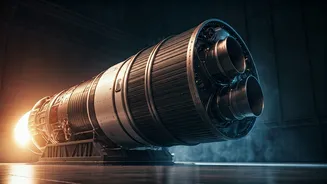
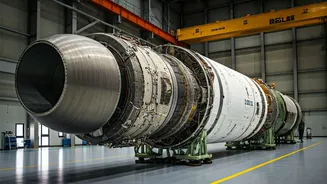
While SOLVE is a new vehicle, it's built on a foundation of trusted ISRO technology. The solid propulsion stage of the rocket is derived from the strap-on motors used in the workhorse Polar Satellite Launch Vehicle (PSLV). However, it has been significantly modified to meet the unique requirements of the Gaganyaan program. These modifications include a slower-burning propellant to achieve the specific flight profile needed for the tests, a straight nozzle, and a new thrust vector control system for steering. This approach of adapting existing, reliable hardware allows ISRO to develop the new test vehicle efficiently and cost-effectively.
The Road to Gaganyaan
The successful ground test of the SOLVE motor is a major milestone for Gaganyaan, India's first crewed space mission. The mission aims to send Indian astronauts into a low-Earth orbit and return them safely, which would make India only the fourth nation to achieve this feat independently. Before astronauts ever board the capsule, ISRO is committed to a series of uncrewed missions to test every system. Vehicles like SOLVE are instrumental in this verification process, proving that the crew escape and recovery systems work flawlessly. These tests, while less headline-grabbing than a launch to the Moon, form the very bedrock of a safe and sustainable human spaceflight programme, demonstrating a commitment to astronaut safety above all else.