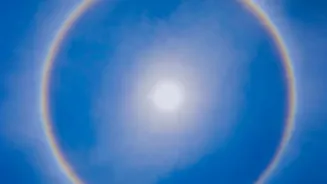







Not Fire, Not a Rainbow
First, let's clear up the name. A 'fire rainbow' has nothing to do with fire, and it isn't a rainbow in the traditional sense, which is formed by raindrops. The correct scientific term is a circumhorizontal arc. The fiery nickname likely comes from its
flame-like appearance when seen in patchy, wispy clouds. Unlike a typical rainbow that arches across the sky after a storm, a circumhorizontal arc is a broad, colourful band that runs parallel to the horizon. It's formed not by liquid water, but by light interacting with tiny ice crystals in high-altitude clouds. The colours are often purer and more vibrant than those in a rainbow because of the unique way the light is split.
A Precise Recipe of Sun and Ice
Seeing a circumhorizontal arc is rare because the conditions have to be perfect. First, you need the sun to be very high in the sky—at an elevation of 58 degrees or more above the horizon. This is why they are more commonly seen in the summer months and at mid-latitudes; locations above 55 degrees latitude (north or south) rarely see the sun get high enough. Second, you need high-altitude cirrus clouds. These thin, wispy clouds, found above 20,000 feet, are so cold that they are composed of millions of tiny, hexagonal (six-sided) ice crystals instead of water droplets. For the magic to happen, these plate-shaped crystals must be oriented horizontally, like tiny dinner plates floating parallel to the ground.
How the Light Bends
The spectacular colour display is a matter of physics. When sunlight at a high angle enters the vertical side face of a horizontally aligned, plate-shaped ice crystal, it bends, or refracts. It then refracts again as it exits through the crystal's bottom face. This double bending acts just like a glass prism, splitting the white sunlight into its component spectrum of colours. Because the millions of ice crystals in the cirrus cloud are all aligned in a similar way, they collectively act as one giant prism, painting the sky with a massive band of colour. The red light always appears at the top of the arc, with violet at the bottom.
NASA’s High-Definition Viewpoint
While the basic science has been understood for some time, new images from space, like one recently featured by NASA, provide unprecedented detail. NASA's Astronomy Picture of the Day (APOD) highlighted a particularly vivid circumhorizontal arc, explaining that images like these help confirm and refine scientific models. By observing the phenomenon from above, satellites can capture the arc's vast scale and the specific cloud formations, like cirrus fibratus, that produce them. These observations are crucial for understanding exactly how uniformly the ice crystals must be aligned to create such a cohesive and brilliant display. The 'reframing' isn't a complete rewrite of the science, but a sharpening of the details, confirming that the precise horizontal alignment of countless crystals is the key factor.
How to Spot This Rare Wonder
Want to see one yourself? Your best bet is on a clear summer day, around midday, when the sun is at its highest point in the sky. Look for thin, wispy cirrus clouds. Because the arc forms far below the sun, you won't be looking directly at it. In fact, the arc is located about 46 degrees below the sun, which is roughly twice the distance of a common 22-degree sun halo. It can be so large that it appears as a disembodied splash of colour in the sky, especially if the cirrus cloud is patchy. While rare, keeping an eye out during the right conditions might reward you with one of nature's most dazzling optical illusions.