





A Messenger From the Moon
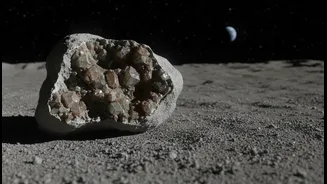
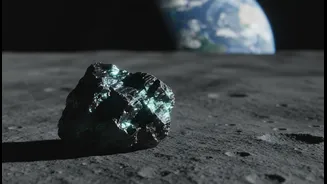
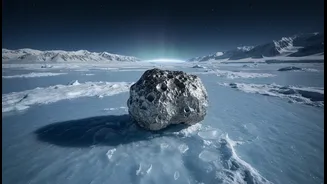
In 1982, scientists on an expedition in Antarctica's Allan Hills region discovered a small, unassuming rock. This meteorite, designated ALHA 81005, was special. After analysis, it was confirmed to be the very first rock found on Earth that had originated
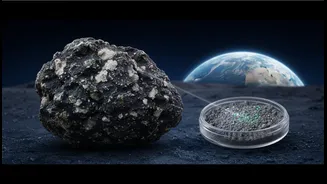
from the Moon. It was a messenger from our celestial neighbour, blasted off the lunar surface by an asteroid impact millions of years ago, sent on a journey through space, and eventually landing on Earth's iciest continent. For decades, ALHA 81005 has been a prized sample for lunar scientists, offering a tangible piece of the Moon that could be studied in laboratories. However, its exact origin on the vast lunar surface remained a tantalising mystery.
India's Triumph at the South Pole
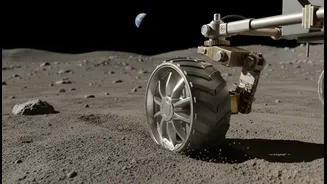
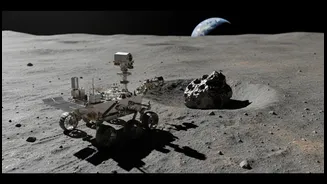
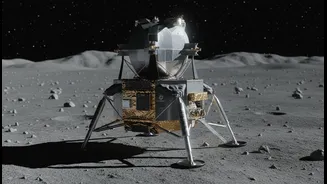
Fast forward to August 2023. India’s Chandrayaan-3 mission achieved a historic soft landing near the Moon's south pole, a feat celebrated across the nation and the world. Its Pragyan rover began exploring the area around the 'Shiv Shakti' landing site, deploying its advanced instruments. One key instrument, the Alpha Particle X-ray Spectrometer (APXS), was tasked with analysing the elemental composition of the lunar regolith, or soil. The data it sent back was revolutionary, providing the first-ever on-site ground-truth about the chemical makeup of this unexplored polar region, confirming elements like aluminium, calcium, iron, and sulphur.
Connecting the Chemical Fingerprints
Recently, scientists at India's Physical Research Laboratory (PRL) in Ahmedabad decided to compare the APXS data from Chandrayaan-3 with the known chemistry of 66 lunar meteorites found on Earth. As they sifted through the data, one sample stood out: ALHA 81005. The chemical match was remarkably close. The soil at Shiv Shakti Point contained about 26.1% aluminium oxide, while the meteorite had 25.8%. The combined iron and magnesium oxide content was also nearly identical, around 14% for both. Both samples occupied a rare compositional space, different from typical lunar highlands, which are usually richer in aluminium and poorer in magnesium and iron.
A Two-Way Street of Validation
This discovery is more than just a cosmic coincidence; it's a powerful, two-way validation of scientific precision. Firstly, it provides a strong clue about the origin of the ALHA 81005 meteorite, suggesting it came from a region geologically similar to the Moon's southern highlands. Secondly, and perhaps more importantly for India, it validates the world-class accuracy of the instruments aboard Chandrayaan-3. The fact that data collected by the Pragyan rover on the Moon so perfectly aligns with detailed lab analysis of a meteorite on Earth proves the reliability and precision of ISRO's technology. ISRO scientists clarified that this doesn't mean the meteorite came from the exact landing spot, but that both samples represent a similar type of magnesium-rich lunar crust.
Unlocking Deeper Lunar Secrets
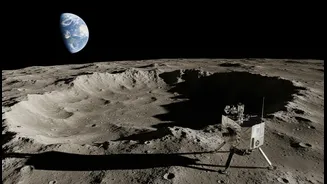
The findings do more than just connect two distant samples; they open new doors to understanding the Moon's formation. The unique chemical signature of the soil suggests it is a mixture, containing not just surface material but also rocks from deeper within the Moon's crust. Scientists believe this deeper material was likely excavated and thrown across the surface billions of years ago by the colossal impact that formed the South Pole-Aitken basin, one of the largest craters in the solar system, located about 350 km from the landing site. This evidence supports the 'Lunar Magma Ocean' hypothesis—the idea that the Moon was once covered in molten rock, which slowly cooled and solidified to form the different layers of its crust.