




A Visit to Pluto's Heart
When NASA’s New Horizons spacecraft flew by Pluto in 2015, it revealed a world far more complex than the static, frozen ball many expected. The mission's most iconic image was of a massive, heart-shaped feature officially named Tombaugh Regio. The western
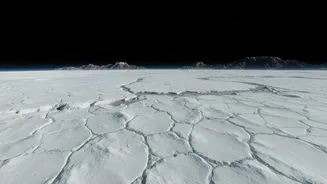
lobe of this feature, a vast basin called Sputnik Planitia, is a colossal glacier of frozen nitrogen larger than Texas and Oklahoma combined. Most strikingly, this plain was almost entirely free of impact craters, suggesting its surface is geologically young—perhaps less than a million years old—and is constantly being renewed from within.
The Puzzling Dark Streaks
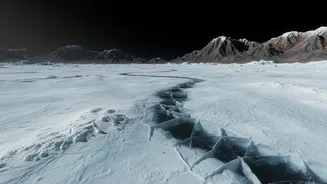
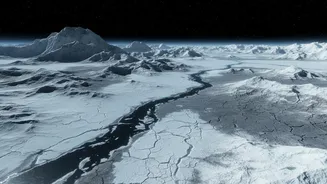
Across the bright, icy canvas of Sputnik Planitia, scientists noticed something peculiar: a network of thin, dark lines and wider, more diffuse dark patches. These features often traced the boundaries of city-sized convection cells, polygonal shapes in the ice that indicate slow, churning movement. The origin of these dark markings has been a puzzle. On a world as frigid as Pluto, where surface temperatures hover around -230°C, conventional explanations like solar heating are too weak to create such distinct patterns. The features, however, looked uncannily similar to patterns seen on Earth's own ice sheets where meltwater has darkened the surface.
A Liquid Nitrogen Solution
A new study published in the Planetary Science Journal provides a compelling answer. An analysis of the New Horizons imagery suggests these dark features are caused by liquid nitrogen occasionally wetting the surface. While liquid nitrogen rain is impossible under Pluto's thin atmosphere and extreme cold, the theory proposes a different mechanism. Scientists believe that deep beneath the glacier's surface, the immense pressure from the overlying ice, possibly combined with a small amount of heat from Pluto's rocky core, could be just enough to melt the nitrogen ice at its base. This is a process known as basal melting.
From the Depths to the Surface
According to the research, this subsurface liquid nitrogen could then be forced upward through cracks and fissures in the vast ice sheet. When this liquid reaches the surface, it temporarily 'wets' the frozen nitrogen ice before re-freezing. This wetting process darkens the ice, much like water darkens sand on a beach. The liquid might enlarge the ice grains or deposit dark impurities, creating the sharp, linear streaks and softer patches observed by New Horizons. Alan Stern, the principal investigator of the New Horizons mission, noted that this finding suggests a new kind of time-variable feature on Pluto, hinting that the surface we see isn't static but changes over time.
A Dynamic World on the Edge
This is the first evidence of recently flowing liquid on Pluto's surface, fundamentally changing our perception of the dwarf planet. It paints a picture of a geologically active world, not a dead one. This activity isn't just limited to potential liquid flows; scientists have also identified towering water-ice mountains that behave like rock, flowing glaciers, and evidence of past tectonic activity. The idea that a body so far from the Sun, in the frigid outer reaches of our solar system, can generate enough internal pressure and perhaps heat to sustain liquid—even liquid nitrogen—is a profound discovery. It forces us to rethink the conditions under which planetary activity can occur.