


The Cosmic In-Betweeners
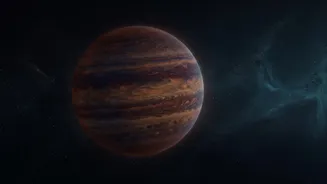
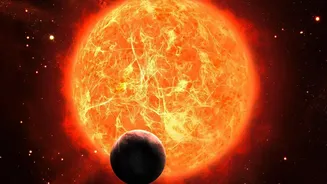
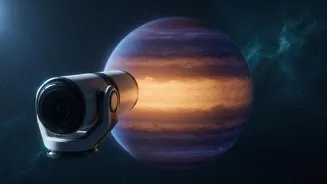
Imagine an object more massive than Jupiter but not quite massive enough to become a star. That’s a brown dwarf. Often called ‘failed stars’, these celestial bodies form from the collapse of gas and dust, just like stars do. However, they never accumulate
enough mass—about 75 to 80 times the mass of Jupiter—for their cores to become hot and dense enough to ignite and sustain the stable hydrogen fusion that powers stars like our Sun. Instead of shining brightly, they emit a faint glow from their leftover heat, slowly cooling and fading over billions of years. This puts them in a fascinating middle ground: they are not stars, but they are not quite planets either, sharing characteristics with both.
A Natural Laboratory for Alien Skies
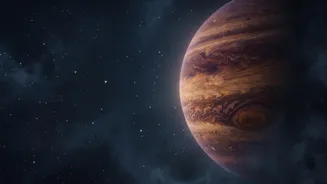
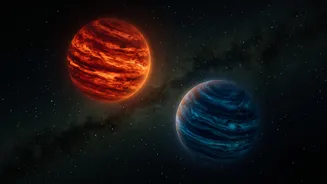
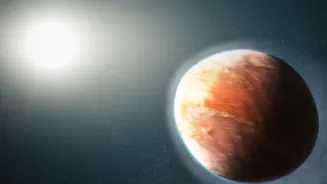
The key to their usefulness lies in their striking resemblance to gas giant exoplanets, often called 'Super-Jupiters'. Many brown dwarfs have similar temperatures, masses, and atmospheric compositions to these enormous planets. Their atmospheres contain a complex mix of molecules and exotic clouds, which might be made of materials like silicates, molten iron, or salts. However, studying the atmosphere of an exoplanet is incredibly difficult. The overwhelming glare from its host star usually washes out the faint light reflecting off the planet's atmosphere. Brown dwarfs, on the other hand, are often found drifting alone in space. This isolation is a gift to astronomers. With no parent star to obscure the view, scientists can get a much clearer, direct look at the atmospheric chemistry and weather patterns of a brown dwarf.
Decoding the Light
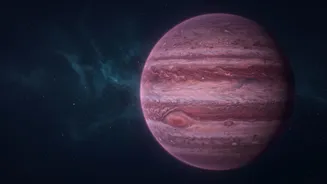
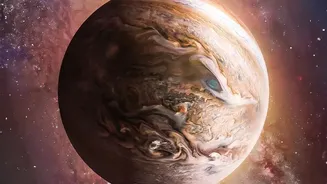
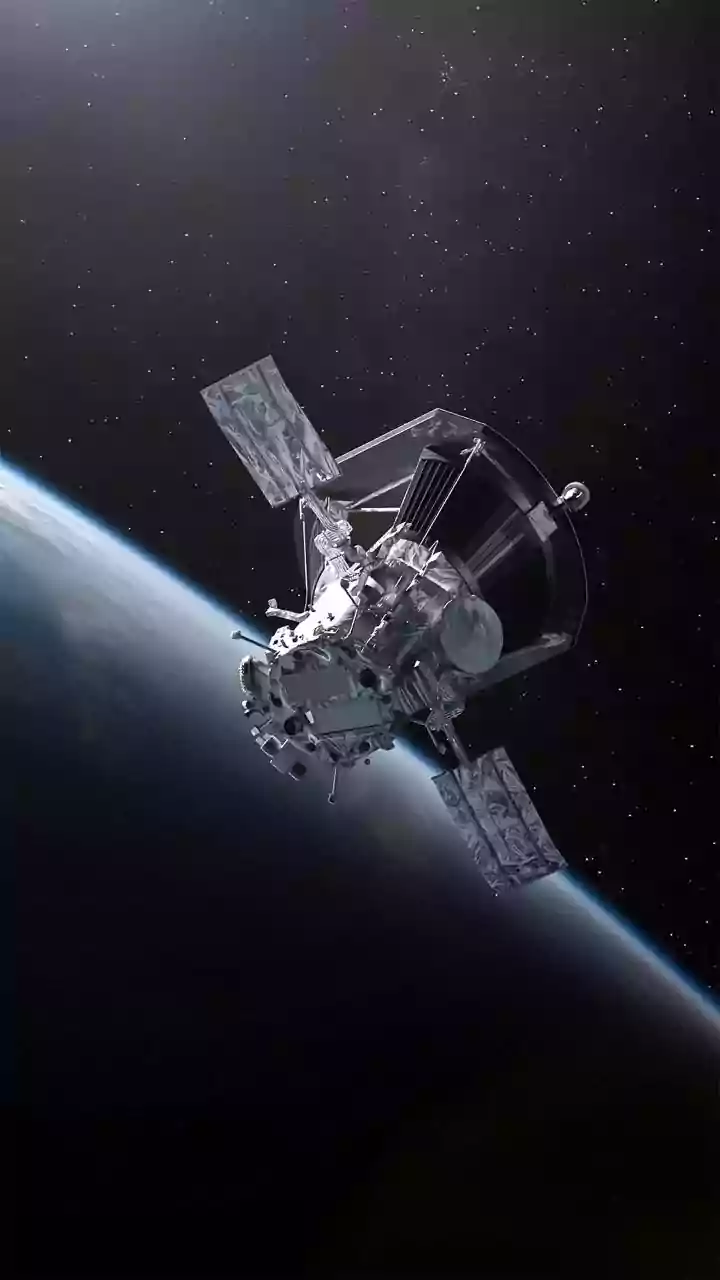
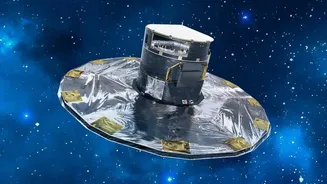
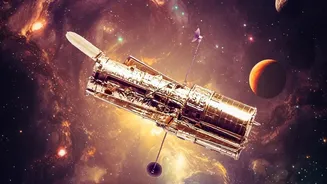
Scientists use a technique called spectroscopy to study these distant atmospheres. By capturing the infrared light from a brown dwarf and breaking it down into its constituent wavelengths, they can identify the chemical fingerprints of different molecules like methane, carbon dioxide, and water. Telescopes like NASA's Spitzer, the Hubble Space Telescope, and now the James Webb Space Telescope (JWST) have been instrumental. Recent findings from NASA's SPHEREx telescope, which launched in 2025, are helping to analyse thousands of brown dwarfs, revealing their rich and diverse chemistry. By observing how the brightness of a brown dwarf flickers and changes over time, scientists can map its cloud cover and even deduce the presence of massive, planet-scale waves and storm systems, similar to the turbulent bands seen on Jupiter.
From Failed Star to Planetary Rosetta Stone
The data gathered from brown dwarfs acts as a template, or a guide, for understanding gas giant exoplanets. When astronomers find a Jupiter-like planet around a distant star, they can compare its likely atmospheric properties to those of a well-studied brown dwarf of a similar temperature and mass. This allows them to build more accurate models of what an exoplanet's atmosphere might contain and how its weather might behave, even when they can't see it directly. For example, understanding the cloud structures and chemical transitions in a brown dwarf's atmosphere helps scientists interpret the limited data they can collect from a faraway exoplanet. This approach helps refine what to look for with powerful tools like the JWST, which can provide unprecedented detail but has limited time to observe any single target.