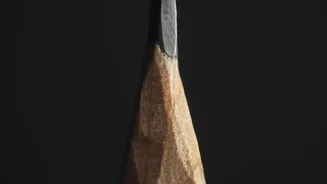








It's one of the first tools we learn to use, a staple of classrooms and offices everywhere. But the writing core of the humble pencil carries a historical secret: its 'lead' contains no actual lead at all, and never has.
A Case of Mistaken Identity
The long-standing confusion dates
back to the 16th century. When a large, unusually pure deposit of a dark, solid mineral was discovered in Borrowdale, England, locals found it perfect for marking sheep. At the time, with chemistry in its infancy, observers mistook the substance for a form of lead ore. They called it 'plumbago', from the Latin word for lead, 'plumbum'. The name stuck. Even though scientists later identified the material as a crystalline form of carbon, the term 'lead' had already become cemented in everyday language. The actual name for this mineral, graphite, was coined in 1789, derived from the Greek word 'graphein', which means 'to write'.
The Graphite That Started an Industry
The Borrowdale deposit was a game-changer because the graphite was so pure and solid that it could be sawn into sticks. Early users simply wrapped these fragile sticks in string or sheepskin to provide stability and keep their hands clean. This was the birth of the pencil. Soon after, artisans developed the now-familiar method of encasing the graphite stick between two carved halves of wood, which were then glued together. For a long time, England held a monopoly on pencil production because of its exclusive access to this high-quality graphite. The material was so valuable, partly for its use in making moulds for cannonballs, that the mines were taken over by the Crown and heavily guarded.
The Modern Pencil Core: A Recipe of Clay and Carbon
Pencils today are a bit more sophisticated. The breakthrough came in 1795 when a French officer named Nicolas-Jacques Conté developed a new method. Facing shortages during the Napoleonic Wars, he devised a process to mix lower-quality, powdered graphite with clay and water to form a paste. This mixture was then shaped into rods and fired in a kiln. This innovation not only made pencil production more efficient but also allowed manufacturers to control the pencil's characteristics. By varying the ratio of graphite to clay, they could create different levels of hardness. More clay results in a harder, lighter-marking pencil (designated with an 'H'), while more graphite produces a softer, darker one (designated with a 'B' for blackness). The common HB pencil sits right in the middle, a balance of hardness and blackness perfect for everyday writing.
From Pencils to High-Tech Applications
The special properties of graphite that make it ideal for writing are all thanks to its molecular structure. It consists of layers of carbon atoms that are weakly bonded together. When you write, these layers easily slide off and stick to the paper, leaving a mark. But graphite's talents don't end with pencils. This unique form of carbon is an excellent conductor of electricity and a fantastic lubricant even when dry. Today, it is a critical component in a vast range of modern technologies, including batteries, brake linings for cars, and industrial machinery. From marking sheep in a Cumbrian field to powering our devices, the journey of this remarkable material is a testament to how a simple discovery can shape the world in unexpected ways.