

From Tech Demo to Science Scout
The incredible success of the Ingenuity helicopter, which proved powered flight was possible in Mars's thin atmosphere, was just the beginning. Ingenuity was a technology demonstration, a four-pound marvel that completed 72 flights but carried no scientific
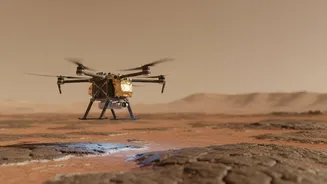
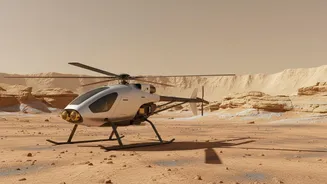
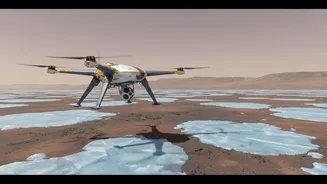
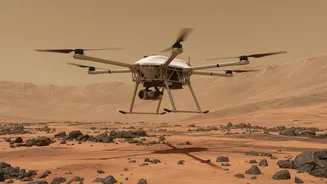
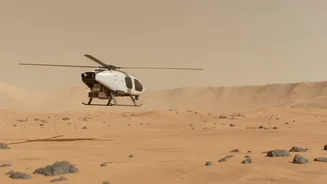
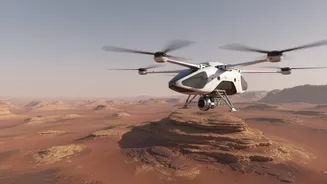
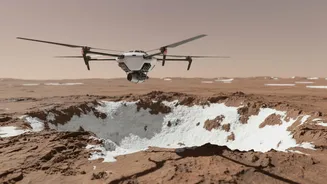
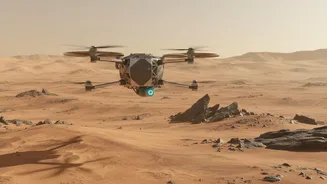
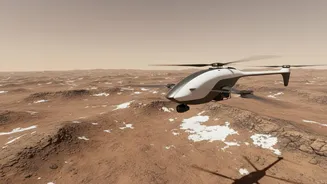
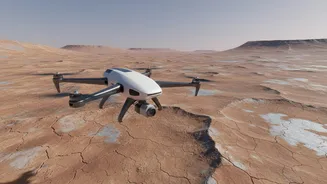
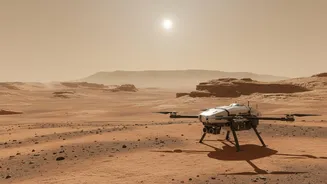
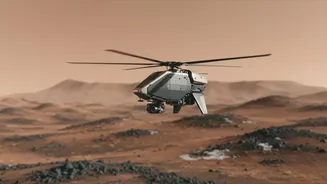
instruments. It was the Kitty Hawk moment for Mars. Now, NASA's Jet Propulsion Laboratory (JPL) is designing the next generation: the Skyfall mission. This concept envisions sending a trio of larger, more capable helicopters that will not just fly, but actively hunt for resources. Unlike Ingenuity, which hitched a ride on the Perseverance rover, these autonomous rotorcraft are designed to be deployed mid-air, land themselves, and conduct science independently, representing a major leap in planetary exploration strategy.
Reading the Ground from the Air
So how do you find something that’s buried underground while you're flying? The Skyfall concept plans to do this using a suite of sophisticated instruments, with ground-penetrating radar being the star of the show. Orbiting spacecraft have mapped Mars for years, but their radar can't resolve the fine details in the top few metres of soil, which is exactly where easily accessible ice is predicted to be. By flying low and slow, a Skyfall helicopter could get a much clearer picture. The key instrument is a lightweight, flexible radar antenna that looks like a cape hanging below the helicopter. This 'cape' sends radar waves into the ground and reads the echoes that bounce back, allowing scientists to create a 3D map of the subsurface.
Decoding the Signals for Ice
The data returned by the Skyfall helicopters would look like a series of layered images of the ground beneath. The process is about interpreting these signals. A strong, clear signal that bounces off a distinct layer just a few feet down could indicate a boundary. Scientists would then analyze the properties of that signal. Dry Martian dust and rock (regolith) will reflect radar waves differently than water ice. By 'reading' how the radar waves are altered as they pass through and reflect off different materials, scientists can distinguish between dry soil and ice-rich deposits. The goal is to identify a shallow, extensive layer that is highly consistent with the properties of ice. This allows them to map not just its presence, but its depth and size, creating a treasure map for future missions.
More Than Just One Trick
While the ground-penetrating radar is crucial for seeing underground, the Skyfall helicopters would carry other instruments to build a more complete picture. A near-infrared imager would analyze the surface composition, looking for minerals that are often associated with water. Other sensors could measure atmospheric conditions like temperature and wind, helping to understand the modern Martian climate. Some concepts for aerial scouts also involve neutron spectrometers. These instruments don't directly detect water, but instead measure hydrogen, its key component. By bombarding the ground with neutrons and measuring how they scatter back, the device can create a map of hydrogen concentration. A high concentration of hydrogen in a specific area is a strong indicator of water ice.
The Ultimate Martian Resource
Finding accessible water ice on Mars is not just an academic exercise; it's the key to unlocking a sustainable human presence there. Buried ice is a potential source of drinking water for astronauts. Through a process called electrolysis, it can be split into hydrogen and oxygen. Oxygen is essential for breathing, and both elements are primary components of rocket fuel. Being able to produce these resources on Mars, rather than hauling them all the way from Earth, would dramatically reduce the cost and complexity of future missions. Concepts like Skyfall, scheduled for a potential launch in the late 2020s, are therefore more than just science missions. They are vital reconnaissance, scouting the landscape for the resources that will one day help humans take their next giant leap.